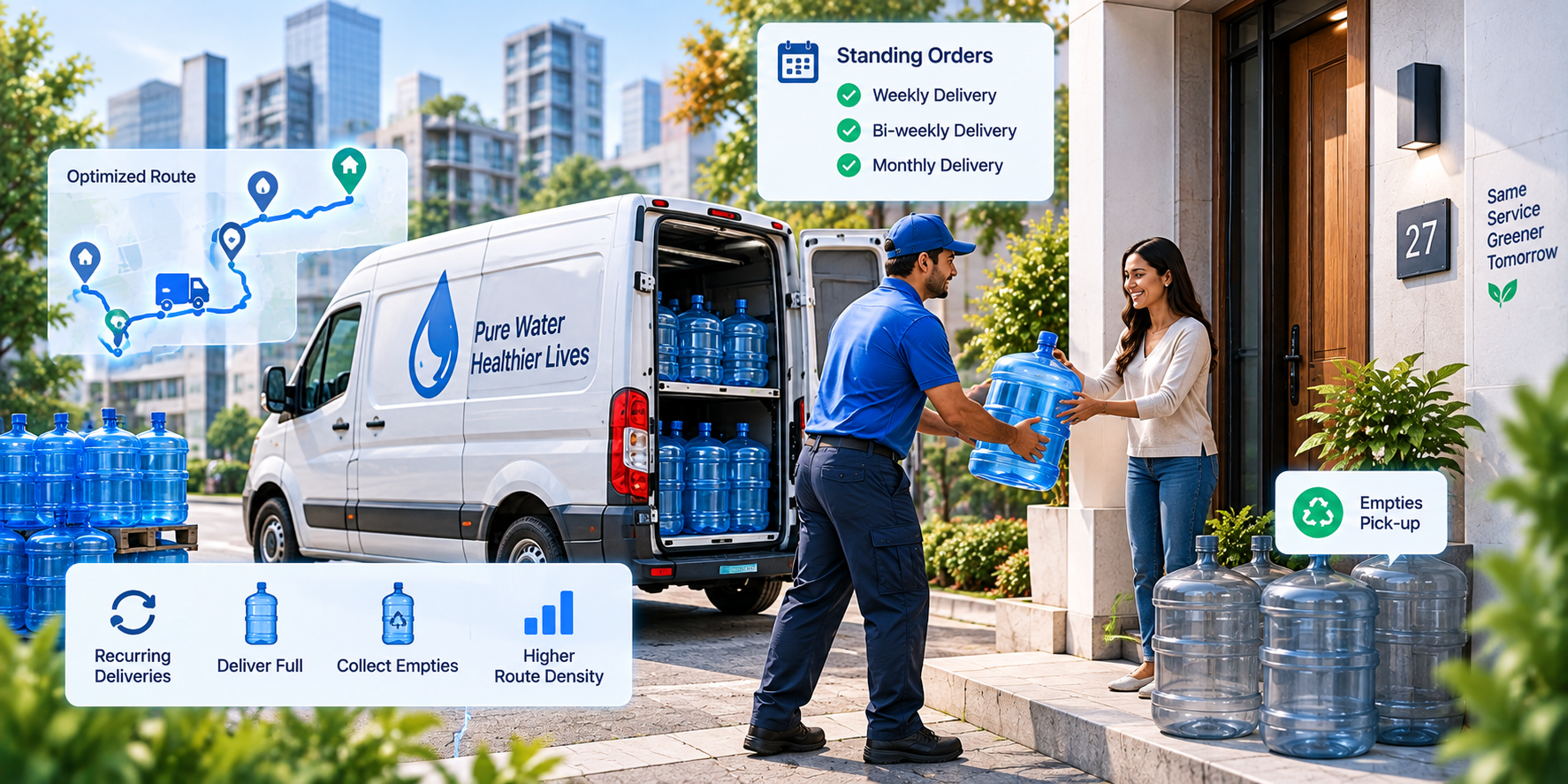
A bottled-water business does not complete its work when the driver leaves a full container at the door. The reusable bottle stays on the customer account until it is collected, exchanged or charged. Meanwhile the next order may already be scheduled. That makes the operation a recurring inventory network with a delivery route attached, not a set of independent drops.
Good water delivery management software preserves stable rounds while giving dispatch enough flexibility for holidays, quantity changes, urgent top-ups and new customers. It also gives the driver one clear number at every stop: how many full bottles to leave, how many empties to expect and what to record when those figures differ.
How should standing water orders generate routes?
Model the subscription separately from each delivery. The standing order stores cadence, normal quantity, preferred day, service window, price and container balance. A scheduled process creates the actual job far enough ahead for capacity planning. Pausing one holiday occurrence must not delete the underlying subscription.
- Generate jobs one or two planning cycles ahead so volume is visible before vehicles and drivers are committed.
- Keep a customer’s normal weekday and route unless a measurable service or cost issue justifies moving it.
- Treat quantity edits as changes to one occurrence unless the customer explicitly changes the subscription.
- Require a reason for skipped service so demand forecasting can distinguish holiday pauses from churn.
- Place new customers into an existing round based on sustainable weekly density, not only today’s spare capacity.
Why empty-container collection belongs in the same stop
The driver action is an exchange with two quantities. Recording only delivered bottles forces finance to reconstruct container liability later. The stop should show expected empties, let the driver enter actual empties and calculate the resulting balance immediately. A photo or customer acknowledgement can support disputes for high-value commercial accounts.
| Event | Full bottles | Empty bottles | Account effect |
|---|---|---|---|
| Normal exchange | Deliver ordered quantity | Collect same quantity | Balance unchanged |
| Customer returns extra empties | Deliver order | Collect more | Container balance falls |
| Customer has fewer empties | Deliver order | Collect fewer | Balance or deposit owed rises |
| Pickup-only closure | Deliver none | Collect remaining assets | Account can close after reconciliation |
How to plan vehicle capacity for full and empty bottles
Departure load is only half the calculation. Full bottles reduce as the route progresses while empties accumulate. If bottle formats have different weights or rack positions, track each as a separate capacity dimension. The planner should calculate load after every stop and reject sequences that exceed a safe limit at any point.
For routes with predictable exchanges, sequence can flatten the load curve: serve high-full, high-empty customers earlier and pickup-heavy accounts after the vehicle has created space. Commercial dispenser service or payment collection may add dwell time even when bottle quantity is small, so service time should be set by customer type.
Do not re-optimize stable rounds every morning
A familiar driver often completes a recurring water round faster than a mathematically shorter unfamiliar route. Preserve the base sequence and optimize exceptions around it unless planned-versus-actual data shows a persistent problem.
How to raise route density without weakening service
Use zone-day mapping: each area gets one or two service days, and new customers are offered windows that fit those rounds. This concentrates demand before optimization begins. Same-day promises across the whole city produce thin routes, high fuel cost and inconsistent arrival times. A dense fixed-day model can still offer an urgent-delivery surcharge when capacity exists.
| Metric | What it measures | Operational use |
|---|---|---|
| Stops per kilometre | Geographic density | Decide where to add or consolidate service days |
| Bottles per driver hour | Delivery productivity | Compare rounds with different order sizes |
| Container recovery rate | Reusable asset control | Find accounts or routes with growing balances |
| Standing-order change rate | Demand volatility | Set reserve vehicle capacity |
| First-attempt service rate | Access and schedule quality | Improve reminders and delivery notes |
A practical rollout plan for a water delivery operation
Begin with one established round and clean the customer schedule before changing the route. Confirm cadence, normal quantity, address pin, access note, service time and current container balance for every account. In week one, run the digital plan beside the existing manifest and resolve data gaps. In week two, let the driver record actual full and empty quantities in the app. In week three, activate customer ETA messages and exception reasons. Only after those records are reliable should the team test sequence changes or insert new customers automatically.
Review the pilot with dispatch, the driver, customer service and finance. Dispatch should see fewer manual edits; the driver should have one unambiguous exchange instruction; customer service should answer balance questions from the order history; and finance should reconcile deposits without a second ledger. If one group still needs a private spreadsheet, the workflow is not yet complete.
How Geofleet supports bottled-water delivery
Geofleet combines recurring order generation, route planning, vehicle capacity, driver workflows, live tracking and proof of delivery. Water operators can build stable zone-based rounds, record full and empty quantities at the same stop, notify customers of arrival windows and compare planned versus actual performance. Geofleet becomes the shared operating record for dispatch, drivers and customer service instead of three spreadsheets with different balances.
Related reading
Frequently asked questions
What is water delivery management software?
It manages recurring bottled-water orders, route planning, driver dispatch, customer notifications, proof of delivery and reusable-container balances in one workflow.
How do standing orders work for bottled-water delivery?
A reusable subscription record generates individual delivery jobs on a weekly, biweekly or monthly schedule. Customers can skip or change one occurrence without deleting the schedule.
How should a driver record empty bottles?
The driver should see the expected empty quantity, enter the actual number collected and update the customer’s container balance at the stop, ideally with timestamped proof.
What is the best KPI for a water route?
Stops per kilometre and bottles per driver hour together show density and productivity. Add container recovery rate to make sure apparent delivery growth is not hiding reusable-asset losses.