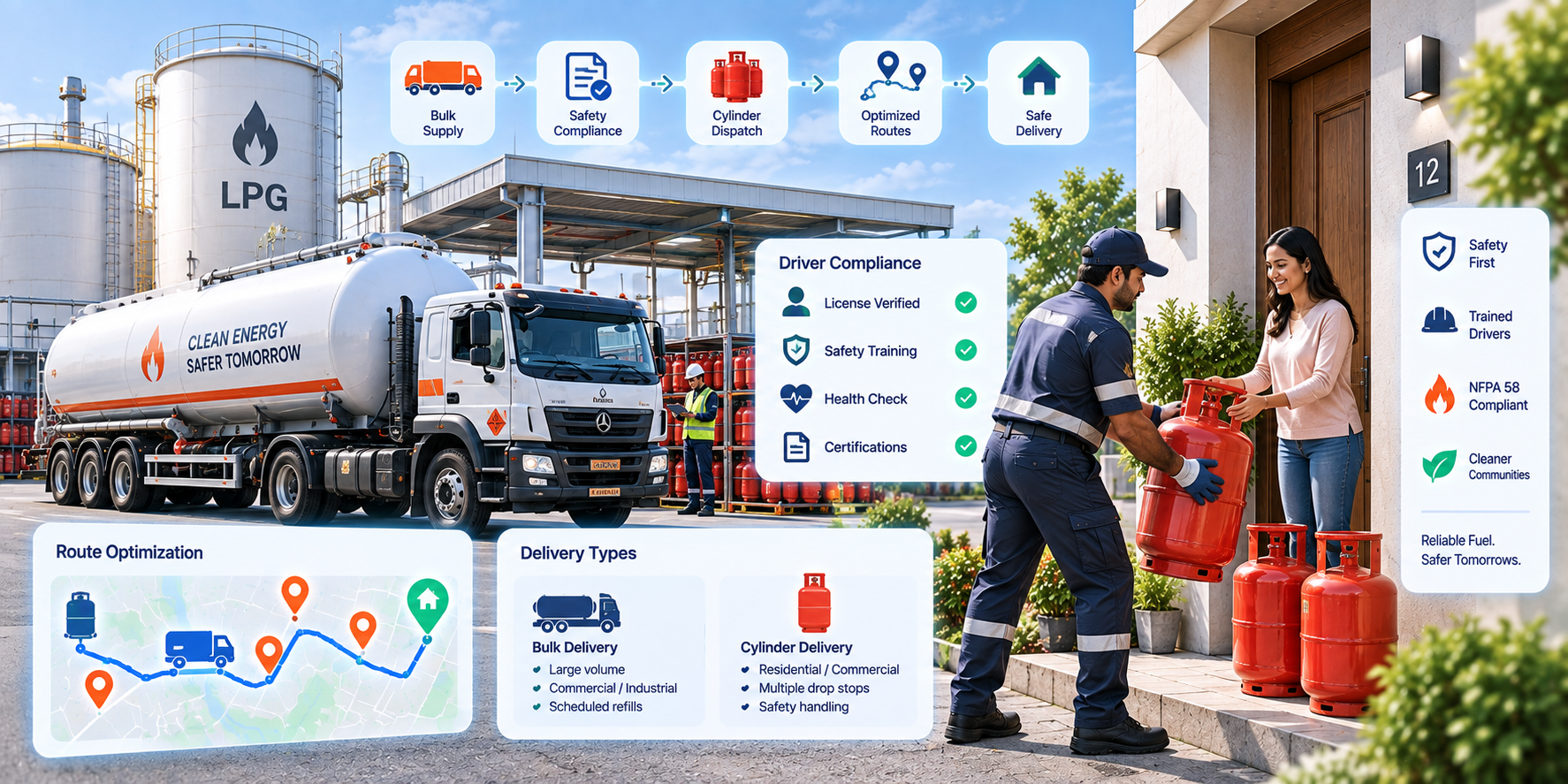
Fuel distribution is a constrained routing problem in which an invalid assignment can be far more serious than a late parcel. An LPG operator may run bulk tankers, cylinder trucks or both. Each fleet has its own load units, service times, access requirements, training rules and documentation. Combining them in a generic “delivery” queue removes the information a dispatcher needs most.
The safe design is a hierarchy. First determine whether the order, driver, vehicle and road path are eligible under the operator’s approved policies and applicable jurisdiction. Only then optimize among valid choices for time, distance and utilization. The route engine should never trade a mandatory rule for a shorter journey.
How bulk LPG and cylinder delivery workflows differ
| Dimension | Bulk delivery | Cylinder delivery |
|---|---|---|
| Load unit | Volume or mass loaded and dispensed | Count by cylinder type and condition |
| Customer asset | Fixed tank with safe-fill limit | Exchangeable or returnable cylinders |
| Service time | Access, connection, transfer and closeout | Unload, exchange, inspect and acknowledge |
| Capacity logic | Running compartment or tank volume | Vehicle positions, weight and cylinder mix |
| Reverse flow | Normally none at the stop | Empty cylinders return to depot |
| Proof | Meter quantity plus delivery record | Delivered and returned counts by type |
Because the data differs, the driver workflow must differ too. A bulk stop may require tank identification, safe-fill calculation and metered quantity. A cylinder stop may require full-versus-empty counts, seal or condition checks and customer acknowledgement. One universal completion button invites missing evidence.
What should LPG route eligibility check before optimization?
- Driver training, licence and certification status required by the operator and jurisdiction.
- Vehicle class, inspection status, capacity, equipment and permitted product types.
- Order type, product, quantity, customer installation and any special handling notes.
- Approved road, tunnel, bridge, urban-time or site restrictions configured by the safety team.
- Shift, break and duty limits, plus enough time for the real service procedure at each stop.
- Depot loading availability and whether compartment or cylinder inventory can fulfil the route.
Treat NFPA 58 and local rules as governed configuration
Where NFPA 58 applies, translate approved procedures into eligibility checks and forms with your safety lead. In other markets, configure the relevant national and local requirements. This guide is an operational framework, not legal or safety advice.
How to dispatch cylinder exchanges
Cylinder delivery behaves like delivery and reverse logistics on the same route. The truck leaves with full cylinders in several sizes and returns with empties that may require condition grading. Capacity is not simply total count: the mix, securing positions and weight matter. The route should show expected exchange quantities and allow the driver to record actual returns by type.
Standing commercial customers can be organized into fixed-day rounds, while urgent residential orders enter a same-day pool. Keep enough reserve capacity for leaks, outages or priority customers without silently overloading normal routes. If a failed delivery changes the expected empty return, update the vehicle’s projected load for every later stop.
How to dispatch bulk replenishment
Bulk planning begins with demand and safe-fill constraints. Telemetry or customer readings can predict which tanks need service, but dispatch should retain the source reading and the planning assumption. The route engine allocates expected volume across vehicles, then recalculates available load as deliveries complete. Actual metered quantities feed inventory and the next demand forecast.
Site access can dominate drive time. Record gate hours, approach restrictions, hose distance, contact procedure and previous service duration. A customer with a short geographic detour can still be an expensive stop if the vehicle must wait for access or cannot safely approach the fill point.
What belongs in the LPG delivery audit trail?
| Stage | Evidence to retain | Question it answers |
|---|---|---|
| Planning | Order, eligibility rules and route version | Why was this driver and vehicle selected? |
| Pre-trip | Required vehicle and load checks | Was the route released ready for service? |
| Arrival | Timestamp, geofence and site acknowledgement | Was service performed at the correct installation? |
| Completion | Actual quantity, exceptions, recipient and proof | What changed hands and under what conditions? |
| Closeout | Returned cylinders, remaining stock and incidents | Does depot reconciliation match the field record? |
How to introduce LPG dispatch software safely
Start with a governed requirements workshop led by operations and safety owners. List each product and job type, the eligible vehicle classes, required qualifications, capacity units, road or site restrictions, checklists, proof and escalation contacts. Configure a limited depot or route, then compare every software assignment with the approved manual plan. The pilot is successful when the system blocks known invalid combinations and preserves the evidence reviewers expect—not merely when it produces a shorter route.
Roll out in controlled stages. First digitize orders and proof without changing dispatch decisions. Next enable eligibility warnings and planning recommendations with mandatory human approval. Add automation only after exception and audit records show the rules are behaving consistently. Keep configuration ownership named, version changes and review any material legal or procedural update before it reaches live planning.
How Geofleet supports governed fuel delivery workflows
Geofleet provides configurable order types, driver and vehicle attributes, capacity-aware route planning, digital checklists, live execution, proof of delivery and audit history. LPG operators can separate bulk and cylinder workflows while dispatchers monitor both from one command centre. Configuration should be reviewed and approved by the operator’s safety and compliance owners before production use.
Related reading
Frequently asked questions
What is LPG delivery software?
LPG delivery software manages orders, eligibility, capacity, routing, driver execution and delivery evidence for bulk fuel and cylinder distribution.
Can bulk and cylinder deliveries use the same workflow?
They can share a platform, but they should use separate order, capacity and completion workflows because the load units, reverse flow and proof requirements differ.
Does route optimization ensure LPG compliance?
No. It can enforce rules configured by qualified owners and block ineligible assignments, but the operator remains responsible for applicable law, safety procedures, training and review.
How are empty cylinders handled in route planning?
Record expected and actual returns by cylinder type, then update the projected vehicle load after each stop so later assignments remain within the approved capacity model.