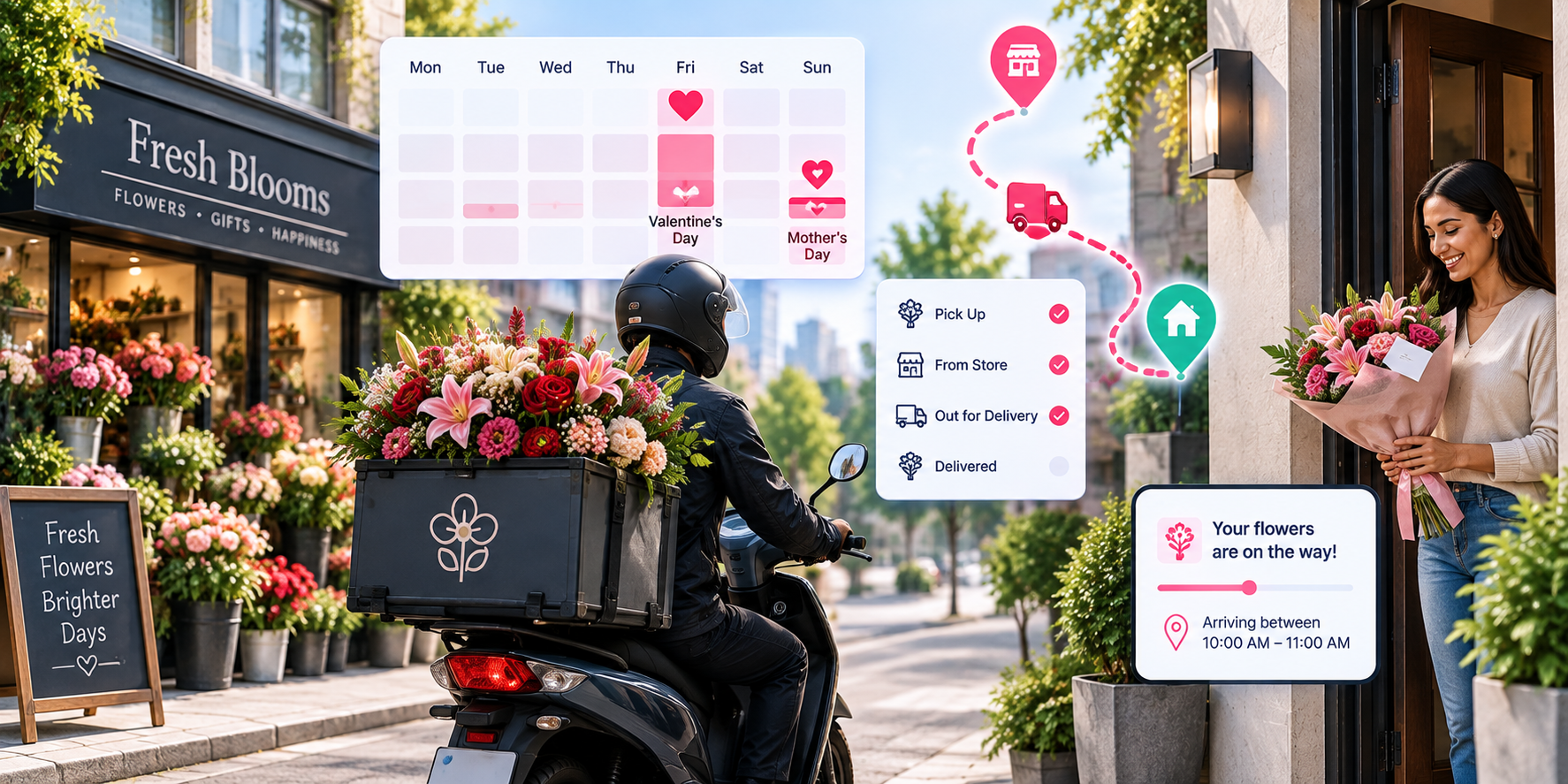
A flower shop can appear to have a simple last-mile operation: collect a bouquet and drive it to an address. The complexity sits underneath. Orders arrive through a website, phone, marketplaces and walk-ins; production time varies by arrangement; recipients are often different from buyers; and demand can multiply in a single day. Generic parcel routing sees addresses. A florist operation has to see promises, readiness and product condition.
The operating goal is not merely shortest distance. It is to deliver the right arrangement inside the promised window, protect it in transit, preserve the surprise where requested and leave an auditable outcome if nobody answers. That means the order record must carry information from checkout all the way into the driver app.
Why florist delivery software needs a peak-day operating model
Normal-week averages are dangerous when a large share of annual volume lands on a handful of dates. A fleet that comfortably handles forty orders on Tuesday may face four hundred on Valentine’s Day. Hiring extra drivers helps only if the shop also caps slots, stages orders by route, verifies addresses early and prevents late production from blocking an entire wave.
| Control | Decision | Failure prevented |
|---|---|---|
| Slot capacity by zone | How many orders checkout can promise | Selling more timed deliveries than the fleet can serve |
| Production cutoff | When an order becomes eligible for a wave | Drivers waiting while arrangements are still being made |
| Vehicle and load rules | Which arrangements travel together | Crushed bouquets and unstable tall arrangements |
| Overflow threshold | When to release a partner or reserve driver | Discovering the capacity gap after windows start |
Separate the commercial promise from the operational window
Customers may buy “morning”, “afternoon” or “before 5 pm”, while the route planner needs a narrower working window based on zone and wave. Store both. The commercial promise is what the customer sees; the operational window is what dispatch uses to sequence the route. If the plan changes, the system should prove the new route still fits inside the customer promise.
How to route timed flower deliveries without damaging route density
Start by locking truly fixed orders: funerals, weddings, venue handovers and paid timed upgrades. Build geographic clusters around those anchors, then place flexible residential orders into the remaining capacity. Optimizing every order as if it had a hard fifteen-minute window creates unnecessary vehicles. Treating every order as flexible breaks the occasions that cannot move.
- Use realistic service time for apartments, hospitals, offices and gated communities instead of one global dwell time.
- Keep large or fragile arrangements early enough in the sequence that they are not repeatedly moved during unloading.
- Assign routes only after production marks each order ready, or reserve a clearly labelled late-ready wave.
- Recheck route feasibility whenever a premium timed order arrives after the original cutoff.
- Give dispatch a visible unassigned queue so an order cannot disappear between the florist bench and the van.
Use two cutoffs
Set an order-acceptance cutoff and an earlier route-lock cutoff. Orders received after route lock should enter an overflow workflow with an explicit price and feasibility check, not silently overload a published route.
How recipient-not-sender tracking should work
Most delivery platforms assume the account holder is the recipient. Florists frequently have three people in the record: buyer, recipient and shop. The buyer needs confirmation and final proof. The recipient needs an ETA, access question and safe-place option. The shop needs both conversations attached to the order. Sending every update to the buyer creates “where is it?” calls while the actual recipient remains unreachable.
A strong flow asks the buyer for the recipient’s mobile number and permission to contact them, then sends a neutral message that does not reveal the gift details. The tracking page should show a narrowing ETA and allow access instructions without displaying the buyer’s note. After delivery, the buyer receives completion proof according to the consent and privacy settings on the order.
What happens when the recipient is not available?
The failed-attempt policy should be decided before the driver reaches the door. Acceptable outcomes may include a concierge handover, neighbour, safe place, shop return or redelivery. The driver app should present only the options approved for that order and capture a photo, recipient name or reason code. “Left somewhere” is not proof and creates a dispute that the shop cannot resolve.
| Situation | Driver action | Customer communication |
|---|---|---|
| No answer, safe place approved | Photograph arrangement and location | Send completion with photo |
| Office or hospital | Record desk and recipient name | Send named handover confirmation |
| Address error | Pause and contact dispatch | Ask recipient for corrected pin |
| No safe option | Return to shop or approved redelivery | Send reschedule link and buyer update |
Metrics that reveal whether florist delivery is healthy
Measure promise-kept rate by window type, orders per driver hour, late-ready orders, first-attempt success, damage claims and support contacts per hundred deliveries. On peak days, compare planned capacity with accepted volume by hour. A good route score cannot rescue a production queue that releases half its bouquets after the departure time.
How Geofleet supports flower delivery operations
Geofleet is an AI-powered delivery management platform that connects order intake, readiness, capacity-aware route planning, live driver execution, recipient tracking and proof of delivery. Florists can plan fixed and flexible windows together, publish staged waves, send branded tracking to recipients and monitor exceptions from one command centre. The result is a workflow built around the occasion promise rather than a generic parcel scan.
Related reading
Frequently asked questions
What is florist delivery software?
Florist delivery software manages flower orders from readiness through routing, driver dispatch, recipient tracking and proof of handover. It should support timed windows, fragile-load rules and buyer-versus-recipient communication.
How should florists plan Valentine’s Day deliveries?
Set capacity by zone and time band before checkout accepts the order, lock fixed-event deliveries first, stage bouquets by route and route only orders marked ready. Keep reserve capacity for address corrections and failed attempts.
Should tracking go to the buyer or recipient?
Operational tracking should usually go to the recipient, with neutral wording that preserves the surprise. The buyer should receive order confirmation and delivery completion proof.
Can route optimization handle timed flower deliveries?
Yes, when the planner distinguishes hard event windows from flexible residential promises and includes preparation readiness, service time, vehicle capacity and arrangement handling rules.