AI agents that run dispatch, carriers & exceptions
Purpose-built for logistics: autonomous agents allocate drivers and carriers, replan routes, contain exceptions, protect SLAs, and keep customers informed — from one AI command centre. No generic chatbots bolted onto a map.
Logistics agent roles
Decisions grounded in real logistics signals
Generic LLM chat can’t see your network. Geofleet agents consume structured operational data — orders, vehicles, carriers, hubs, and customer commitments — so every recommendation or autonomous action reflects what is actually happening on the ground.
Order & OMS stream
Line items, service levels, cutoffs, and priority flags flow in continuously from your commerce and ERP stack.
Live GPS & telematics
Vehicle position, dwell, speed, and route adherence give agents ground truth for replanning and ETAs.
Carrier capacity & rates
Lane availability, tender responses, and performance history inform who gets the next load — not spreadsheets.
Hub & sort windows
Inbound waves, dock doors, and labor plans so agents don’t overload a site that’s already at capacity.
Disruption context
Weather, events, and traffic anomalies trigger proactive reroutes and customer messaging before SLAs slip.
COD, POD & exceptions
Payment rules, proof requirements, and failed-attempt policies drive the next best action automatically.
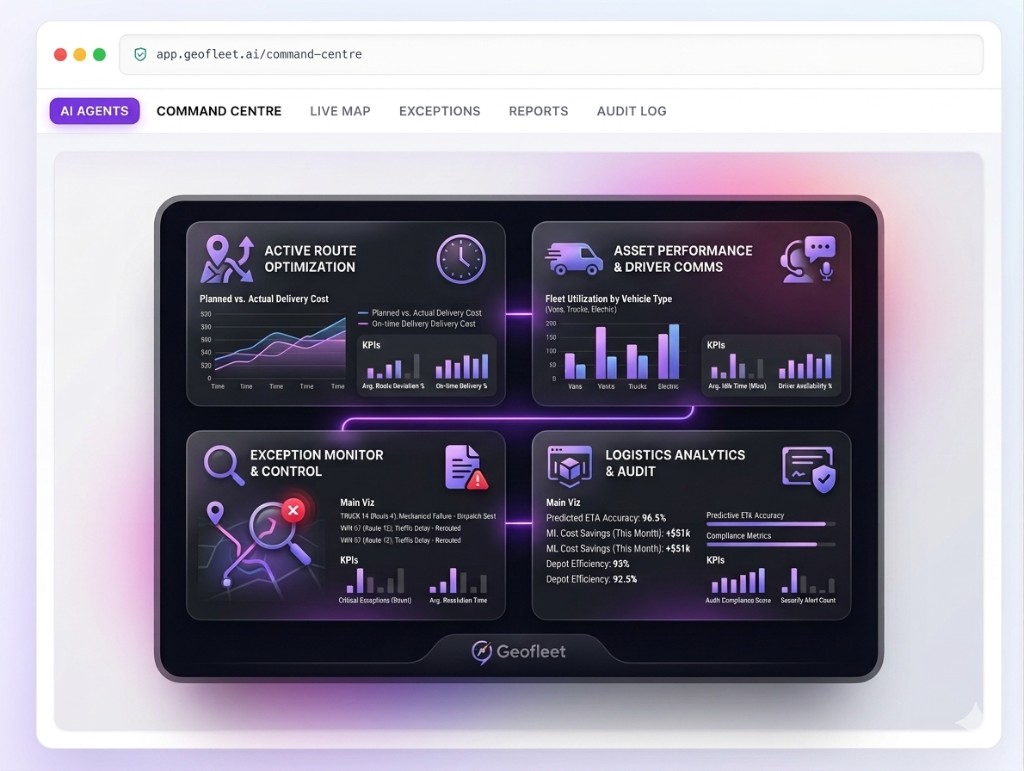
Your agents in the Geofleet command centre
One surface for orchestration, overrides, and audit — built for logistics operators, not demo chat UIs.
Agents across first, middle & last mile
The same command centre can orchestrate multiple legs of a shipment. Agents share context so a delay on linehaul automatically reshapes last-mile promises — instead of siloed teams reconciling in chat.
First mile & hub intake
Agents align pickup waves, yard sequencing, and carrier handoffs so upstream volume doesn’t collapse the sort. Exceptions from mis-scans or short loads are triaged with suggested rework.
Middle mile & linehaul
Linehaul and partner legs get matched to SLAs and cost guardrails. When a trunk is late, downstream last-mile agents rebalance stops and customer comms in the same run.
Last mile & proof
Final delivery agents optimize stop order under live constraints, nudge drivers on at-risk ETAs, and ensure POD / COD rules are satisfied before the job closes.
How logistics agents run
From playbook to live execution to closed-loop learning — without losing operator control.
Define logistics playbooks
Set SLAs, hub rules, carrier tiers, escalation paths, and guardrails. Agents inherit your operating model — not a one-size template.
Agents execute in the stack
Allocation, reroutes, nudges, and notifications fire automatically from live orders, GPS, ETAs, and carrier capacity — no spreadsheet handoffs.
Observe, audit, improve
Every action is logged with context. Tune thresholds, approve overrides, and let models learn from outcomes across your network.
Why agentic beats brittle automation
Rules fire the same way every time. Agents reason over state: what changed, what’s at risk, and what to do next within your policies.
Typical
Manual dispatch
High cognitive load, inconsistent decisions, slow reaction to spikes.
Typical
Static rules only
Brittle when reality diverges; rules don’t learn from outcomes or overrides.
Geofleet
Geofleet AI agents
Context-aware actions across drivers, carriers, and hubs — with audit trails and human gates.
Built for logistics execution — not generic prompts
Each capability maps to real freight, drivers, carriers, hubs, and customer promises — with guardrails and traceability.
Dispatch & allocation agent
Assigns orders to drivers and carriers using proximity, capacity, skills, shift windows, cost, and SLA risk — continuously as the day evolves.
Carrier matcher agent
Selects and books the right carrier per lane, load, and service level; rebalances when delays or failures threaten the plan.
Route recovery agent
Detects missed windows, traffic spikes, and new injections; triggers partial or full re-optimization without waiting for a planner.
Exception containment agent
Triages failed attempts, address issues, and hub bottlenecks — proposes reassignments, customer comms, or human escalation with context.
SLA guardian agent
Monitors promised ETAs and contractual cutoffs; prioritizes work and alerts teams before breaches, not after.
Customer comms agent
Proactive SMS/email/WhatsApp for delays, proof of delivery, and handoff — aligned with your brand and tone.
Hub load-balancing agent
Shifts volume across hubs and sort windows when inbound spikes or labor constraints threaten throughput.
Driver coach agent
Flags risky patterns (idle, rerate, safety) and nudges drivers with contextual coaching — not generic blasts.
Audit & policy agent
Enforces COD, POD, and compliance checks before release; surfaces anomalies for finance and ops in one trail.
Command centre console
Live view of agent decisions, queue depth, overrides, and health across hubs — built for control-tower operators.
Decision trace
Immutable reasoning trail: what the agent saw, what it chose, and why — for disputes, audits, and continuous improvement.
Human-in-the-loop
Low-confidence or high-risk moves route to dispatchers with suggested actions; agents learn from every approval or edit.
Human-in-the-loop when it matters
Autonomy is scoped: agents can propose, nudge, or execute within policies you define. High-impact moves — carrier swaps, large cost deltas, or customer-facing promises — can require approval. Every suggestion and action is attributable so ops and compliance can replay what happened and why.
Policy guardrails
SLA windows, cost ceilings, carrier tiers, and geo rules constrain what agents can do without an override.
Audit trail
Inputs, model reasoning summaries, and outcomes stay tied to orders and trips — not lost in a chat thread.
Role-based gates
Dispatch leads approve exceptions; analysts review cohort performance; admins tune playbooks per lane or hub.
Plugs into the stack you already run
Agents are only as good as the data they see. Geofleet integrates with OMS / ERP, telematics, carrier systems, and customer comms so orchestration stays in one command centre instead of swivel-chair spreadsheets.
Outcomes operators measure
Agentic automation should show up in dispatch load, SLA adherence, and cost per stop.
Agents own routine allocation and rerouting so planners focus on strategy and exceptions.
Events → agent evaluation → action in seconds versus manual queues and handoffs.
Carriers, drivers, hubs, and customers stay synchronized without a patchwork of tools.
Frequently asked questions
How are Geofleet AI agents different from a generic AI chatbot?
They are operational agents wired into orders, routes, carriers, drivers, and SLAs. They take actions (assign, reroute, notify, escalate) with guardrails — not just answer questions in a widget.
Can dispatchers override agent decisions?
Yes. Any assignment or recommendation can be overridden. Overrides are logged and feed back into models so agents align with how your team actually runs logistics.
Do agents work across first mile, middle mile, and last mile?
Yes. Playbooks can span hub intake, linehaul, carrier legs, and last-mile delivery so the same command centre orchestrates the full shipment lifecycle where you operate it.
How do agents improve over time?
Outcomes (on-time, cost, rework, overrides) close the loop. Thresholds and models adapt within your governance rules — you stay in control of what can change automatically.
Which plans include AI agents?
Core AI dispatch and allocation are available on Professional and above. The full logistics agent suite (carrier matching, exception containment, SLA guardian, extended comms) is included on Premium and Enterprise — confirm with sales for your volume and regions.
Put agents on your logistics stack
Start a trial or walk through the command centre with our team — we’ll map agents to your hubs, carriers, and SLAs.
All features