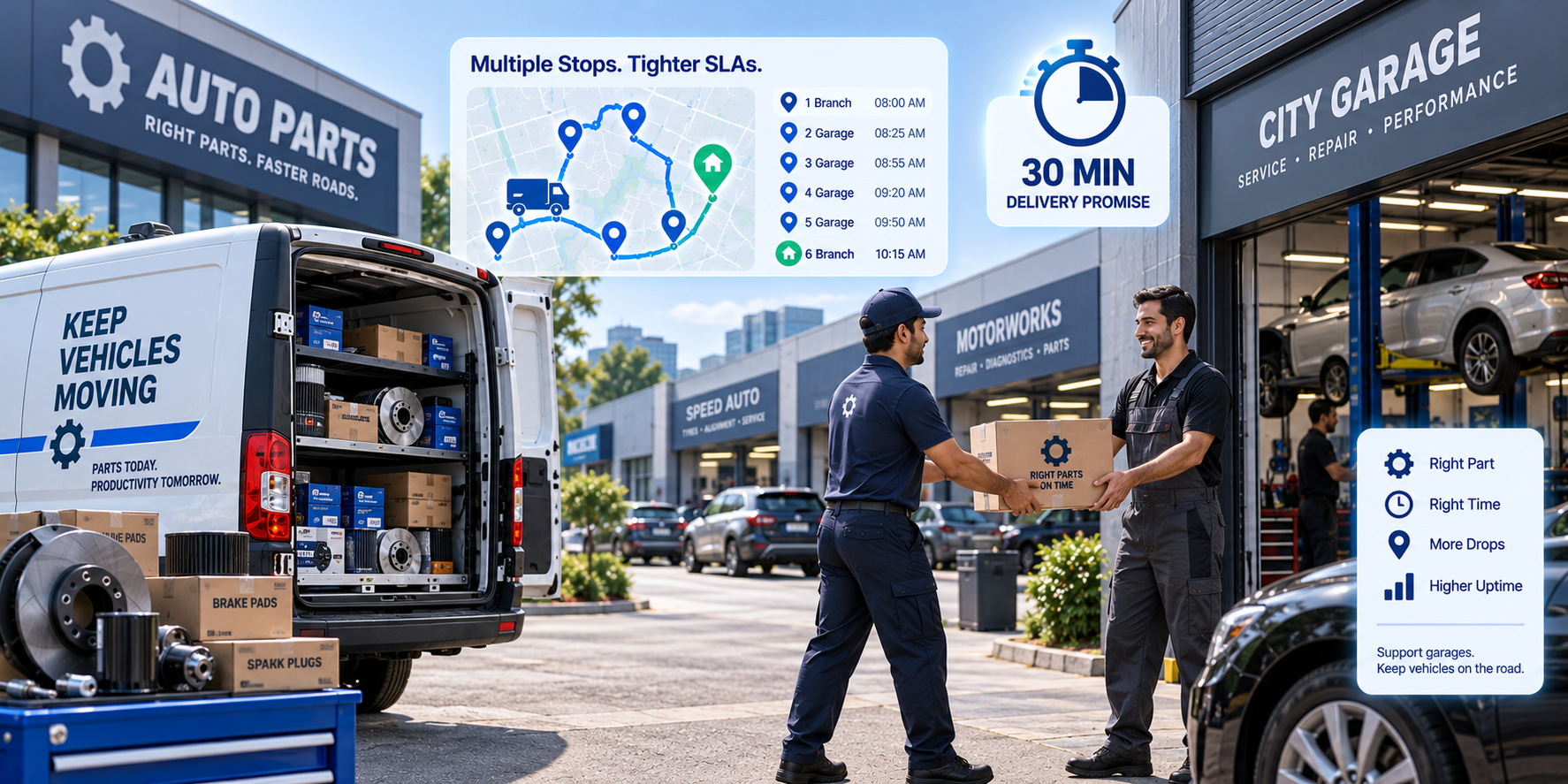
Automotive parts distribution compresses the last mile into a series of short, high-consequence promises. Garages order throughout the day, often after diagnosis, and expect the next branch run to arrive quickly. Drivers return with cores, warranty items and incorrectly supplied parts while new orders continue to enter the queue. The operating system must make these flows visible together.
The best plan is usually a cadence of zone loops rather than one large optimized route. Each loop has an order cutoff, loading window, departure target and maximum duration. Dispatch can then promise “next run” using real capacity instead of an optimistic fixed time that ignores the jobs already committed.
How to design 30-minute and one-hour parts delivery promises
| Order type | Planning treatment | Useful control |
|---|---|---|
| Vehicle-off-road urgent | Priority insert if feasible | Bay status and promised-by time |
| Normal trade order | Next scheduled zone loop | Cutoff and route capacity |
| Stock transfer | Consolidated inter-branch run | Receiving deadline and tote capacity |
| Core or warranty return | Pickup on a compatible delivery stop | Barcode custody and destination |
Do not label every order urgent. Create a reason and commercial rule for priority service, then show dispatch the downstream consequence. A workshop waiting on a safety-critical component may justify resequencing; a routine stock refill probably does not. This keeps priority meaningful and protects the promises already on the vehicle.
How should route loops be planned?
- Map garages into practical trade areas around each branch and assign a normal run cadence.
- Use order cutoffs that leave enough pick, verify and load time before departure.
- Reserve a small, explicit share of route capacity for urgent inserts instead of relying on luck.
- Plan service time by garage, accounting for trade-counter queues, parking and signature requirements.
- Return the driver to the best replenishment branch, which may differ from the departure location in a multi-branch network.
Choose the fulfilment branch before the route
The closest branch is not automatically the right branch. Inventory availability, pick completion, vehicle capacity and later route commitments all matter. Allocation should calculate whether a stocked part can actually reach the garage inside the promise. If a transfer is required, represent it as a linked movement instead of pretending the customer delivery starts from stock that is not there.
Handling urgent orders after a driver has departed
A live insert is worthwhile only if it can be picked before the driver reaches the branch or collection point, fits the vehicle, and does not create a worse SLA breach elsewhere. Show dispatch the impact before confirming: extra minutes, affected stops and revised ETAs. If the insert is not feasible, offer the next loop or assign a dedicated run with its real cost visible.
Measure the promise at handover
“Dispatched in 30 minutes” is not a customer outcome. Measure order received to garage handover, then split the time into pick, wait, drive and service so the true bottleneck is visible.
How returns and cores should move back through the network
A driver collecting a core or incorrect part needs a return task linked to the original order, expected item and destination. Scan at collection and depot receipt. Without that chain, credits wait, branches lose track of valuable cores and the garage calls the sales desk for an answer operations cannot prove.
| Metric | Why it matters | Diagnostic split |
|---|---|---|
| Promise-kept rate | Protects garage uptime | Urgent vs normal, branch and zone |
| Order-to-departure time | Exposes pick and staging delay | Picker, cutoff wave and branch |
| Stops per driver hour | Measures route productivity | Loop and daypart |
| Urgent insert rate | Shows instability or poor stocking | SKU family and garage |
| Return custody time | Protects credits and core value | Collected to branch-received |
A 30-day rollout for one branch
Use one branch and two representative trade areas. During the first week, clean garage pins, service instructions and promised service types; measure current order-to-departure and order-to-handover time. In the second week, publish scheduled loops through the driver app while dispatch keeps urgent assignment manual. In week three, add return scans and customer tracking. In week four, test live insertion with clear approval thresholds and compare the result with the original plan.
The branch should graduate from pilot only when drivers complete proof consistently, the parts counter can see which run owns every order, and the SLA report agrees with a manual sample. Expand one branch at a time so inventory allocation, route cadence and support ownership remain understandable. A fast technical launch with unclear urgency rules simply moves the existing phone queue onto a screen.
How Geofleet supports automotive parts distribution
Geofleet combines multi-branch order visibility, capacity-aware route planning, live assignment, driver scanning, ETA updates and proof of delivery. Dispatchers can run scheduled loops and urgent jobs in one command centre, see the SLA impact before inserting a stop and maintain linked proof for returns. That turns the delivery promise into a measurable branch operation instead of a phone call to the driver.
Frequently asked questions
What is auto parts delivery software?
It manages rapid branch-to-garage orders, repeat route loops, urgent assignment, driver tracking, proof of handover and parts returns.
How do auto parts distributors meet 30-minute delivery promises?
Use dense branch trade areas, frequent loops with fixed cutoffs, fast pick-and-stage workflows and limited capacity reserved for genuinely urgent orders.
Can an urgent order be inserted into a live route?
Yes, when the system checks pick readiness, added travel, vehicle capacity and every affected promise before dispatch confirms the insertion.
How should parts returns be tracked?
Create a return task linked to the original item, scan it at garage collection and again at branch receipt, and retain timestamps and custody in the order history.