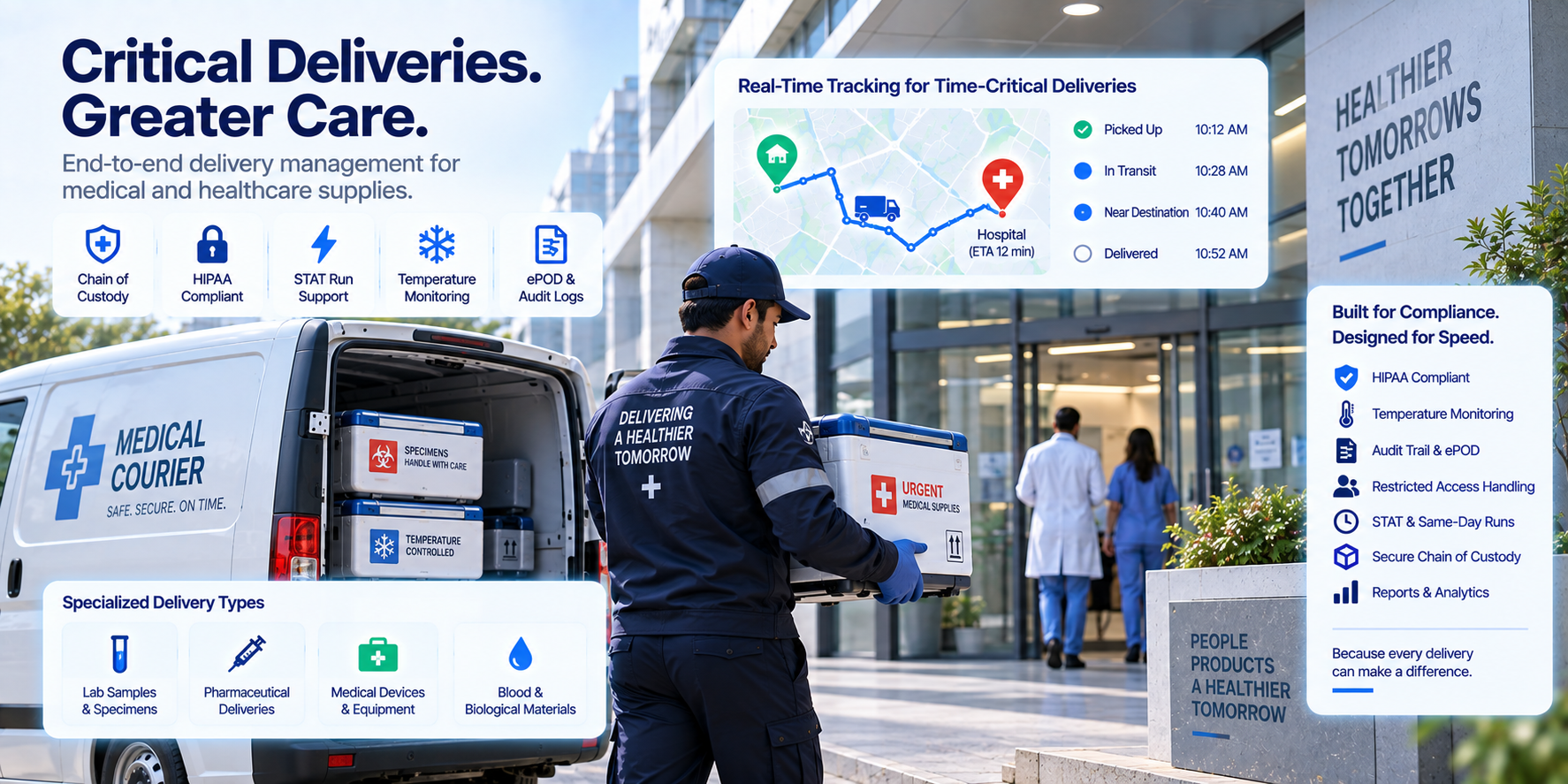
Medical delivery failures can affect care, diagnostic timelines and regulated records. The dispatch problem starts with classification. A routine stock transfer, a diagnostic specimen, a controlled-temperature medicine and a STAT item have different urgency, equipment, proof and access requirements. If they enter the same queue with only a free-text note, the system cannot reliably protect the difference.
This guide describes operational controls, not legal advice. HIPAA applies to protected health information in relevant US contexts, while other jurisdictions have their own privacy and medical-transport rules. Each organization should translate its legal, clinical and laboratory requirements into approved platform configuration, contracts and procedures.
What does medical chain of custody need to record?
| Event | Minimum record | Control objective |
|---|---|---|
| Release | Sender, courier, time, item ID and condition | Prove who accepted responsibility |
| Transport | Route status, required environment and exceptions | Show continuity and detect risk |
| Transfer | Both parties, place, time and item match | Close one custodian and open the next |
| Delivery | Authorized recipient and completion evidence | Prove correct handover |
| Incident | Reason, containment, notification and disposition | Preserve response and audit history |
Barcode or QR scans reduce manual identity errors, but the workflow still needs exception states for damaged labels, refused items, temperature excursions and unavailable recipients. Never force a driver to mark an exception as delivered merely to finish the route. The evidence model should reflect what actually happened.
How should medical courier software handle HIPAA-sensitive data?
Start with data minimization. A driver may need a pickup location, delivery department, contact instruction, item identifier and handling rule. They rarely need diagnosis or clinical notes. Restrict access by role and active assignment, secure data in transit and at rest, record access and administrative changes, and define retention according to the organization’s approved policy.
- Use unique accounts and multi-factor authentication for dispatch and administrative users.
- Limit each courier to the tasks and fields required for the current assignment.
- Avoid sensitive detail in push notifications, SMS previews and exported route sheets.
- Keep proof and audit history tamper-evident with controlled correction workflows.
- Review vendors, integrations and model providers under the organization’s security and contractual process.
How are STAT routes different from scheduled medical runs?
STAT is a response service, not just a high priority score. It needs an intake definition, target acceptance time, qualified-driver pool, reserve capacity and escalation clock. The allocator should consider proximity, current route commitments, vehicle or handling skills and predicted arrival. Dispatch should see which scheduled stops would be affected before assigning a courier already in motion.
Reserve capacity deliberately
If every courier is planned to full utilization, STAT performance depends on cancellations. Protect a response pool by geography and time of day, then measure whether the reserved capacity matches actual urgent demand.
Temperature-sensitive and time-sensitive execution
The order should define the required temperature band, packaging, maximum transit or dwell time and action on excursion. Sensor integration can attach readings to the trip, but a driver still needs clear instructions for delayed handover or damaged packaging. Alerts should reach an accountable role early enough to protect the item, not simply document failure afterward.
Routing must include real service time at hospital docks, labs, pharmacies and controlled-access departments. A route that assumes two minutes at a loading bay will produce false ETAs throughout the day. Capture actual arrival, access and handover time separately so planning can distinguish road delay from facility dwell.
What should happen when a medical delivery is at risk?
| Exception | Immediate action | Evidence |
|---|---|---|
| Courier delay threatens SLA | Assess qualified reassignment or direct run | Decision, revised ETA and notifications |
| Recipient unavailable | Hold item under approved condition and escalate | Contact attempts and disposition |
| Temperature excursion | Follow approved containment procedure | Readings, times and authorized decision |
| Seal or package issue | Stop transfer and notify designated owner | Photos, scan and incident record |
| Wrong item or destination | Quarantine task and verify identifiers | Mismatch and corrective handoff |
How to validate a medical courier workflow before go-live
Create test orders for each service class and include failure scenarios, not only successful handoffs. Verify wrong-recipient prevention, required scans, unavailable recipient, damaged seal, temperature alert, lost connectivity, late courier and attempted administrative access outside role. Clinical, quality, privacy, security and operations owners should review the resulting record and confirm that the system prompts the approved action without exposing unnecessary information.
Pilot with a bounded route and retain the existing escalation contacts. Sample custody records daily, compare predicted and actual facility dwell, and interview drivers about ambiguous instructions. Expand only after the organization can retrieve a complete record quickly and explain every correction. The objective is dependable evidence and response under normal pressure, not a perfect demonstration in a training room.
How Geofleet supports accountable medical delivery
Geofleet supports configurable service types, driver and vehicle eligibility, route planning, live status, barcode workflows, ePOD, temperature integrations, alerts and audit history. Medical courier operators can separate routine and STAT work, keep completion evidence attached to the item and monitor SLA risk from one command centre. The customer remains responsible for configuring Geofleet to its legal, privacy, clinical and quality requirements.
Related reading
Frequently asked questions
What is medical courier software?
It manages classified medical transport orders, qualified assignment, routing, custody scans, live status, temperature or handling evidence, proof of delivery and exceptions.
What is chain of custody in medical delivery?
It is the documented sequence of responsibility for an item, recording who released, transported and accepted it, when and where each handoff occurred, and its condition.
Does medical courier software make an operation HIPAA compliant?
No product alone guarantees compliance. Software can support access controls, minimum-necessary data, audit history and secure workflows, but the organization must govern configuration, policy, contracts, training and response.
How should STAT deliveries be dispatched?
Use a defined urgent-service workflow with qualified drivers, reserved capacity, predicted arrival, SLA timers and escalation. Evaluate the effect on existing medical commitments before reassignment.