Proof of delivery sits at the intersection of three business functions that are usually managed separately: legal and compliance, customer experience, and operations analytics. Most delivery operations treat POD as a checkbox—capture something, store it somewhere, retrieve it if there is a dispute. That approach leaves significant value on the table and creates real exposure when the proof that was captured turns out to be insufficient for the dispute type being adjudicated.
A well-designed POD system is infrastructure, not an afterthought. It shapes what your drivers capture at every stop, what your platform stores and for how long, what customers see before and after delivery, and what your ops team can pull in under 30 seconds when a dispute arrives. This guide covers each layer.
Choosing the Right Proof Type by Delivery Category
Signature Capture
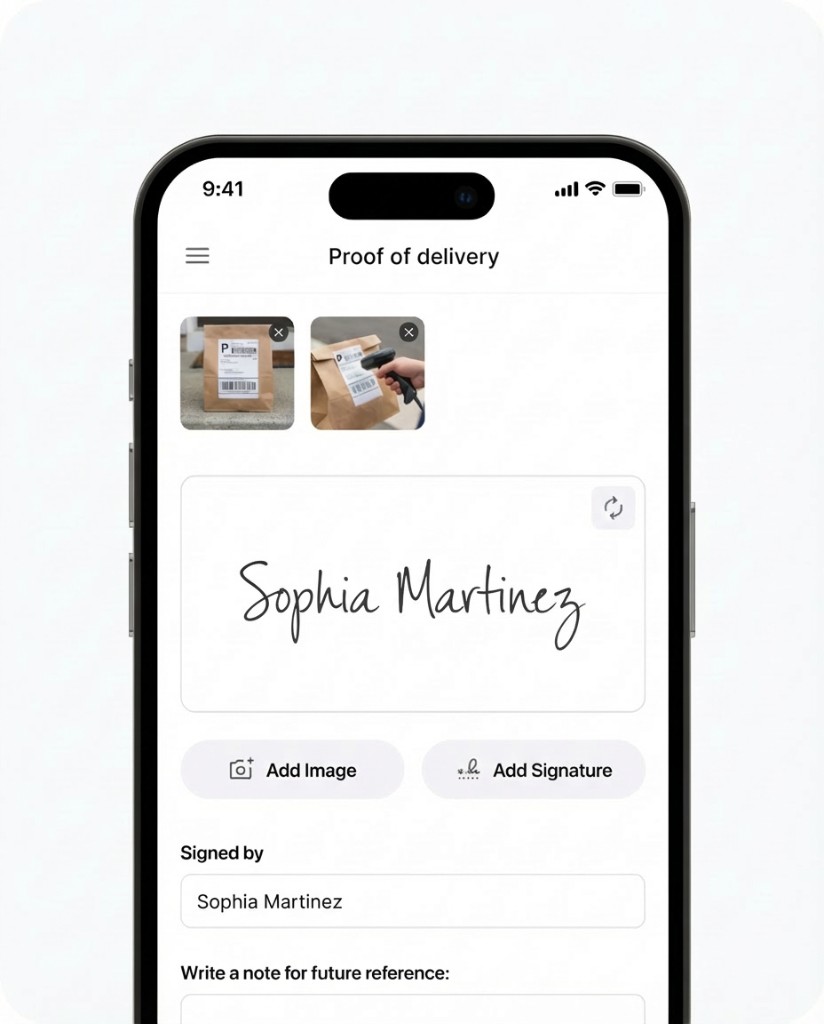
Digital signature is the standard for most delivery categories—B2B drops, furniture, appliances, and any delivery where a named recipient is expected. A valid digital signature with a timestamp and GPS coordinate is legally sufficient evidence of handover in most jurisdictions and is accepted by the majority of payment processors for chargeback disputes. The weakness: signatures are easily challenged when the recipient claims they did not sign or that someone else signed on their behalf. For high-value or high-dispute-rate deliveries, signature alone is insufficient.
OTP Verification
One-time password verification—where the customer receives a code and provides it to the driver at handover—creates a stronger proof of delivery because it requires active participation from a device linked to the customer account. It is harder to repudiate than a physical signature. OTP is the right default for high-value consumer electronics, jewellery, and any category with a history of 'item not received' disputes. The operational downside: OTP fails when the customer has a different phone at the door or has not received the SMS. Build a fallback flow—supervisor call, alternate contact, or secure drop with photo—for OTP failures.
Photo Proof
Photo capture is the right proof type for contactless and unattended deliveries: items left at a door, dropped in a designated safe location, or delivered to a reception desk. A photo with embedded GPS coordinates and timestamp provides visual confirmation of placement. For high-value unattended drops, combine photo with a geo-fence check confirming the driver was within 15 metres of the delivery address. Photo proof alone is weak for disputed deliveries where the customer claims the item was stolen after drop—but combined with a timestamped location match, it substantially shifts the burden of proof.
- Standard parcels and B2B: digital signature + timestamp + GPS
- High-value consumer goods: OTP verification + photo of item at handover
- Contactless / unattended: photo + GPS geo-fence confirmation
- Regulated / pharmaceutical: chain-of-custody log with recipient ID verification
- COD deliveries: signature + cash amount recorded + driver acknowledgement
| Proof type | Repudiation resistance | Best for | Main weakness |
|---|---|---|---|
| Digital signature | Moderate | Standard parcels, B2B | Easily challenged as “not me” |
| OTP verification | High | High-value, dispute-prone goods | Fails if SMS not received |
| Photo + geo-fence | Moderate–high | Contactless / unattended | Weak if item stolen after drop |
| Chain-of-custody + ID | Highest | Regulated, pharmaceutical | Operationally heavier |
"We reduced our disputed delivery chargebacks by 60% in six months—not by adding more proof types, but by making sure the proof we already captured was actually stored, linked to the order, and retrievable in under a minute."
— Head of Last-Mile Operations, Consumer Goods Distributor
Building a Complete Evidence Chain
What a Complete Evidence Chain Looks Like
A complete evidence chain for a single delivery stop contains: a dispatch event with driver assignment and order manifest, location pings confirming the driver followed the planned route, an arrival event with GPS confirming proximity to the delivery address, the proof capture event (signature, OTP confirmation, or photo with timestamp), and a completion event logged in both the driver app and the central platform. Every link in this chain must be stored with a tamper-evident timestamp. If any link is missing, the chain is broken and the proof is contestable.
Multi-Handoff Deliveries
For deliveries that pass through multiple hands—warehouse to trunk courier to last-mile driver—each handoff must be logged as a distinct event with its own proof capture. The chain-of-custody for a regulated delivery must show not just that it arrived, but who had it at every stage and what condition it was in at transfer. Build handoff scanning into your driver app workflows so the chain is captured automatically, not entered manually after the fact.
- Dispatch event: driver assigned, manifest confirmed, timestamp logged
- En-route events: location pings at configurable intervals
- Arrival event: GPS within geo-fence of delivery address, stop timer starts
- Proof capture: signature / OTP / photo with embedded metadata
- Completion event: synced to platform and OMS within 60 seconds of capture
Customer Experience at the Point of Proof
Disclose Proof Requirements at Order Time
The most common POD-related customer complaint is not about the proof requirement itself—it is about surprise. A customer who was not told at checkout that a signature or OTP would be required is far more likely to escalate when the driver asks for it. Disclose proof requirements clearly on the order confirmation page and in the pre-delivery notification. For OTP deliveries, send the code 30 minutes before the driver arrives, not at the moment of arrival.
Handling Failed Proof Capture
Define a clear fallback flow for each proof type failure before it happens. OTP not received: driver calls the support number on the order, supervisor approves an alternative. Customer refuses to sign: driver logs a refusal event with a photo of the customer-addressed door, and dispatch is notified immediately. App failure during photo capture: driver takes a phone camera photo and uploads it at next connectivity point, flagged for manual review. Every failure mode should have a documented resolution path—not a driver making a judgement call at the door.
Data Retention, Access, and Audit Readiness
Match Retention Periods to Legal Exposure Windows
Consumer dispute windows vary by category and jurisdiction. Credit card chargeback windows are typically 120 days from purchase but can extend to 540 days for certain card networks. Regulatory audit requirements for pharmaceutical and alcohol deliveries extend to 2–5 years in most markets. Your POD retention policy must be set by your longest legal exposure window in each category, not by storage cost preferences. The cost of retrieving a POD record is always lower than the cost of losing a chargeback dispute because the record was deleted.
Retrieval Speed Is an Operational Metric
When a customer contacts support claiming non-delivery, your support agent should be able to retrieve the complete evidence chain for that order within 30 seconds. If retrieval requires a manual database query or an email to the ops team, your retention architecture is not fit for purpose. Build POD retrieval directly into your support interface, searchable by order number, customer phone, or delivery date range. Audit this retrieval speed monthly.
Retrieve in under 30 seconds, from the support screen
The proof you captured only protects you if an agent can pull the full chain mid-call. Make POD searchable by order number, phone, and date inside the support tool — and audit retrieval time monthly like any other SLA.
- Standard consumer deliveries: retain POD for minimum 18 months
- High-value and B2B: retain for minimum 3 years
- Regulated categories (pharma, alcohol): retain per category-specific regulatory requirement
- Role-based access: support agents see proof summary; compliance team sees full chain; drivers see only current shift
- Audit log: every access to a POD record should be logged with user, timestamp, and reason
Using POD Data to Improve Operations
POD data is one of the most underused operational datasets in last-mile logistics. Aggregate dispute rates by driver, zone, time-of-day, and delivery category reveal patterns that individual incident reviews miss. A driver with a 3% disputed delivery rate in a specific zone may have a route timing problem, an address resolution issue, or a training gap—all diagnosable from the POD log. Monthly analysis of POD anomalies—failed captures, OTP fallbacks, signature refusals—is a low-cost input into driver training and route quality reviews.
Frequently asked questions
What is the strongest proof of delivery for high-value orders?
OTP verification combined with a photo of the item at handover provides the strongest proof for high-value consumer deliveries. OTP requires active participation from a device linked to the customer account, making it harder to repudiate than a signature. Add a timestamped GPS coordinate to the photo capture to complete the evidence chain.
How long should proof of delivery records be retained?
Retain standard consumer POD records for a minimum of 18 months to cover typical chargeback windows. High-value and B2B deliveries warrant 3 years minimum. Regulated categories—pharmaceutical, alcohol, temperature-controlled—must meet category-specific regulatory requirements, which extend to 2–5 years in most markets. Set retention by your longest exposure window, not storage cost preferences.
Is GPS location data sufficient proof that a delivery was made?
No. GPS data confirms where the driver was, not that the item was handed to the right recipient. Courts and payment processor chargeback teams look for direct evidence of handover—signature, OTP confirmation, or a photo showing the item placed at the correct address. GPS strengthens the evidence chain but does not replace direct proof.
How do I handle a customer who refuses to sign at delivery?
Define a refusal flow in your driver app: driver logs a REFUSED_SIGNATURE event, captures a photo of the addressed door or the customer, and notifies dispatch immediately. The event is logged with GPS and timestamp. Do not allow drivers to override the refusal and mark the delivery as complete—the log of the refusal itself becomes the evidence record if the customer later claims non-delivery.
How does Geofleet handle proof of delivery capture and storage?
Geofleet's driver app supports signature, OTP, and photo POD capture with embedded GPS coordinates and tamper-evident timestamps. All evidence is synced to the platform in real time, linked to the order record, and searchable by support teams within seconds. Retention periods are configurable by delivery category, and role-based access controls limit who can view full evidence chains.