At eight in the morning, a corridor closes. Last night’s batch run was elegant on paper—but it never saw today’s cancellations, that roadwork, or the surge of same-day inserts. If your software only publishes a morning plan, dispatch becomes a manual repair loop: chat threads, spreadsheets, and heroic coordinators. In 2026, the strategic question is not “do we have an optimizer?” but “does our optimizer live inside a closed loop with live data, policies, and—where appropriate—AI assistance that humans can trust?”
The cost of static plans
Of a typical day's routed stops can be affected by intra-day change—cancellations, reschedules, traffic, and same-day inserts. Teams running batch-only plans often absorb this as manual rework rather than automated replanning.
What changed: route planning is now a decision loop, not a nightly job
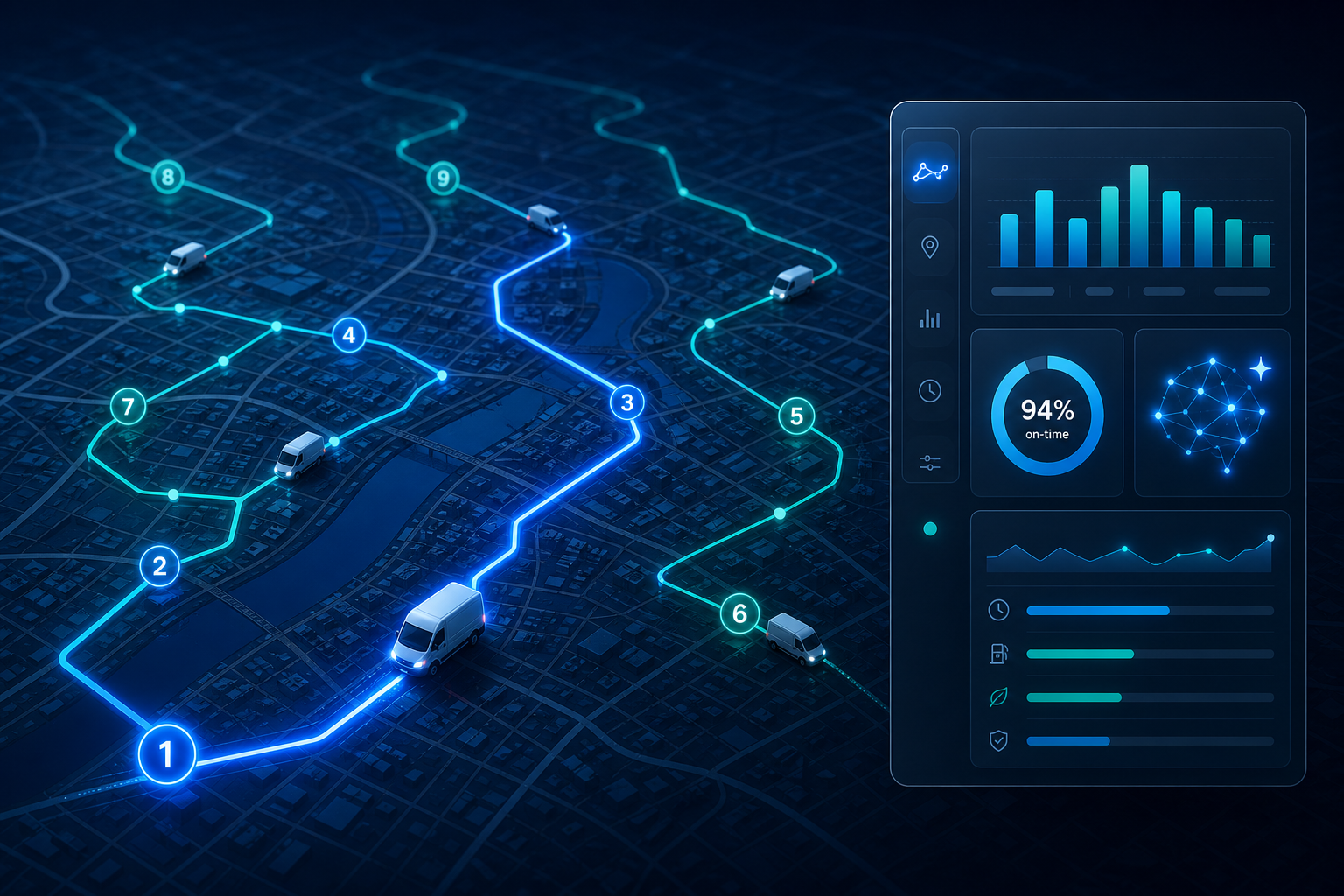
For decades, enterprise routing was summarized as vehicle routing problems (VRPs): assign stops to vehicles under constraints, minimize cost or time. That core math still matters. What changed is the cadence of reality: orders drip in all day, carriers slip, customers rebook windows, and social traffic patterns shift hour by hour. The winning architecture treats routing as a continuous decision loop—sense → decide → act → measure—rather than a single batch file handed to drivers at dawn.
- Sense: orders, inventory holds, telematics positions, traffic, hub capacity, SLA clocks.
- Decide: optimization, rules, and—increasingly—ML risk scores or copilot suggestions within guardrails.
- Act: dispatch changes, driver tasks, customer notifications, carrier tenders.
- Measure: on-time performance, cost per stop, exception dwell, and model drift where AI is involved.
Buyers should map vendor roadmaps to that loop. If “AI” is only a chat widget bolted beside yesterday’s batch solver, you will still drown in exceptions.
What “route planning software” still means—four problem families
Vendors still collapse different products under one label. These categories help RFP teams avoid comparing apples to satellites:
- Navigation & compliance layers: truck-legal paths, restrictions, offline maps—execution-critical, but not fleet-wide constrained optimization.
- Stop sequencing & tour builders: daily multi-stop routes, often single-depot, sometimes light capacity.
- Routing + scheduling: multi-day horizons and recurring work—common in field service patterns.
- Orchestration platforms: routing tied to allocation across hubs and carriers, SLAs, exceptions, and live replanning—typical for retail, FMCG, 3PL, and high-volume e-commerce.
AI does not remove this taxonomy—it raises the bar on what “orchestration” must automate and explain.
Where classical optimization ends—and where AI actually helps
Mature solvers handle hard constraints at scale: time windows, skills, compartments, paired pickups and deliveries, heterogeneous fleets. Machine learning shines where inputs are fuzzy or non-stationary: predicting service times by neighborhood, scoring SLA breach risk before manifests lock, forecasting no-access or fraud patterns, or ranking which exceptions deserve human attention first. Large language models (LLMs) add natural-language interfaces and summarization—“why did route 14 change?”—when grounded in structured operational data, not when asked to invent addresses.
- Predictive ETA and dwell models reduce systematic underestimation that makes “optimal” routes chronically late.
- Risk scoring prioritizes exceptions by revenue, regulatory exposure, or customer tier.
- Copilots accelerate dispatcher work: propose reroutes, draft customer messages, surface policy conflicts—if actions are permissioned and logged.
- Generative UI or NL queries lower training cost for seasonal staff—if answers cite system state, not hallucinate it.
Red flags: “black box” routing with no constraint trace, LLM outputs that bypass approval for money-moving actions, or AI features priced on token volume without caps.
Agentic dispatch: trend, not buzzword
“Agentic AI” in logistics usually means autonomous or semi-autonomous agents operating on the same data graph as your tower: observing assignments, proposing changes, executing within policy, and escalating when confidence drops. That is materially different from a static optimizer plus email alerts. Evaluation questions include: What tools can an agent invoke (re-optimize, reassign, notify)? What roles may approve or veto? What is recorded in the audit trail? How are conflicts resolved when two agents disagree?
Trending integrations—APIs, webhooks, and emerging connector patterns (including MCP-style tool use in some stacks)—matter because agents are only as good as the freshness and fidelity of inputs they can read.
2026 trends shaping route planning RFPs
- Continuous planning vs batch-only: intra-day re-optimization as a default, not a premium module.
- Customer-facing honesty: proactive comms when risk rises, not only post-failure apologies.
- Sustainability with guardrails: CO₂ or km budgets as constraints, not greenwashing dashboards divorced from dispatch.
- Unified telemetry: telematics + order systems + hub scans in one timeline for root-cause on SLA misses.
- Responsible AI procurement: model cards, data residency options, and human-in-the-loop for regulated cargo.
- Labor reality: copilots that shorten training for temps during peaks, without bypassing approvals.
Capability tiers (still useful—without a leaderboard)
Skip “top N” lists; map candidates to tiers based on your network shape:
Tier A — Maps and light optimizers
Fine for experiments and tiny fleets. Rarely encodes enterprise constraints or exception governance.
Tier B — Mid-market route suites
Strong at daily tours, driver apps, and APIs. May strain when allocation, multi-depot policy, and automated exception handling must be native—not improvised in spreadsheets.
Tier C — Enterprise orchestration
Planning, dispatch, visibility, and often carrier or 3PL coordination in one operational graph—where AI copilots and agents deliver leverage because the data model is unified.
Tier D — Developer-first routing APIs
Maximum flexibility; you own UX, observability, and change management. TCO includes engineers on call.
| Dimension | Tier A: Maps / light | Tier B: Mid-market suite | Tier C: Orchestration | Tier D: API-first |
|---|---|---|---|---|
| Constraint depth | Basic distance/sequence | Windows, light capacity | Multi-depot, skills, COD, cold chain | Whatever you build |
| Intra-day replanning | Manual | Partial / triggered | Continuous, event-driven | You implement it |
| AI copilots / agents | Rare | Emerging, often add-on | Native, in the data loop | Bring your own |
| Exception governance | None | Improvised in chat/sheets | Roles, approvals, audit trails | Custom |
| Time to value | Days | Weeks | Weeks to a quarter | Quarters |
| Best fit | Tiny fleets, pilots | Daily tours, SMB ops | Retail, FMCG, 3PL, e-commerce | Engineering-led teams |
Buyer tip
Tier is not a quality ranking—it is a fit decision. A Tier A tool that matches a 12-van single-depot operation will outperform an over-bought Tier C platform no one configures. Anchor the choice to your constraint depth and exception volume, not the longest feature list.
Evaluation checklist: classical + AI dimensions
- Constraint depth and expressiveness for your vertical (cold chain, COD, age-gated, bulky, returns).
- Replanning latency and triggers: what events auto-fire a re-solve vs await a human?
- AI transparency: can you trace why a suggestion appeared? Can you block categories of automated action?
- Data contracts: event-driven integrations, idempotency, sandbox, replay for debugging bad routes.
- Observability: SLA risk surfaces, queue times for exceptions, audit logs tied to finance and compliance.
- Model lifecycle: who retrains predictors, how drift is monitored, and how fallbacks work if a model is disabled.
- Commercial alignment: seat vs order vs outcome pricing vs unpredictable AI usage fees.
Data readiness: the silent killer of AI-enhanced routing
Models amplify bad data. Invest concurrently in geocoding quality, realistic service times by context (B2B vs residential), and hub modeling—dock doors, cutoffs, and wave rules. Feature parity between training environments and production integrations is where many pilots die quietly.
- Instrument actual dwell vs planned; feed that delta back into prediction pipelines.
- Align inventory and substitution rules with what routing is allowed to sequence.
- Treat address validation as part of the ML boundary—do not let models “guess” locations.
TCO in the AI era
Beyond licenses, model planner overtime during peaks, integration sprints, SRE for APIs, and the operational cost of false automation (wrong reroutes, angry customers, rework). If AI features bill by token, scenario-test monthly burn on realistic chat and summarization volumes.
How Geofleet fits: execution-first routing with AI in the loop
Geofleet is aimed at teams where routes cannot be divorced from dispatch reality. AI agents and a command-centre model help teams allocate, explain, and adjust work as conditions change—within roles, policies, and customer-facing surfaces like branded tracking—so optimization is not a morning printout but a living operational system. If your bottleneck is pure navigation or a lightweight daily tour, a smaller tool may suffice; if your bottleneck is SLA risk, surge handling, and coordination volume, evaluate platforms designed for closed-loop execution—not AI slideware.
Proof of concept: stress the loop, not the demo
- Run two hubs with different demand volatility; include a promo window.
- Inject controlled chaos: late trucks, address failures, order inserts—measure time-to-recovery.
- For any AI-assisted action, require: preview, approval path, and post-hoc explanation suitable for ops and compliance.
- Score outcomes on SLA adherence, km/stop, planner minutes, and customer contacts—not demo-day aesthetics.
"The best route planning purchase in 2026 is the one your planners trust on a bad Tuesday: when the map is red, orders are late, and the software helps the team steer—not when it only looks clever on a calm Wednesday screenshot."
Software for route planning is no longer a single-module decision. It is an investment in how intelligently—and safely—your digital plan tracks the physical world. Pick the tier that matches your constraints, demand the closed loop, and hold AI features to the same bar as any other system that can move money, miss SLAs, or message customers.
Related reading
Frequently asked questions
What is route planning software in 2026?
Systems that build and revise delivery or service routes under constraints—now increasingly paired with live data, automation, and AI copilots that assist dispatchers within policies. Navigation-only apps are not substitutes.
How is AI used in route planning?
Common patterns include predicting service times and delays, scoring SLA risk, prioritizing exceptions, natural-language interfaces to operational data, and agentic workflows that propose or execute guarded reroutes and notifications—always with auditability.
What is agentic dispatch?
Software agents observe live operations and take or suggest actions within rules—rerouting, reassigning, messaging—rather than only displaying dashboards. Governance and human approval paths define safe adoption.
Do we still need classical optimization if we have AI?
Yes. Constraints like capacity, windows, and pairing are still solved with optimization engines. AI augments prediction, prioritization, and interfaces—it rarely replaces hard feasibility checks.
What risks come with LLM copilots in dispatch?
Hallucination of facts, unapproved actions if poorly permissioned, and cost drift on token usage. Mitigate with grounded retrieval on system data, role-based execution, and logging.
How is route planning different from navigation?
Planning decides which stops and vehicles; navigation executes movement along roads. Enterprises typically need both, plus a system that keeps them synchronized when plans change.
What integrations matter most?
Order sources, inventory or SKU masters, CRM or promised delivery windows, telematics, and finance/COD flows. Broken feeds make any AI layer unreliable.
How should we measure ROI?
Combine distance and fuel with on-time %, exception handling time, failed attempts, SLA penalties, and customer contact volume. AI value shows up in peak weeks and breach scenarios—not averages alone.
Is an API-only engine enough?
If you can invest in building dispatch UX, monitoring, and governance. Many operations teams need packaged orchestration to avoid maintaining a custom control plane.
What should a pilot prove?
Recovery under disruption, transparency of automated decisions, and measurable SLA and labor impact in realistic—not cherry-picked—lanes.