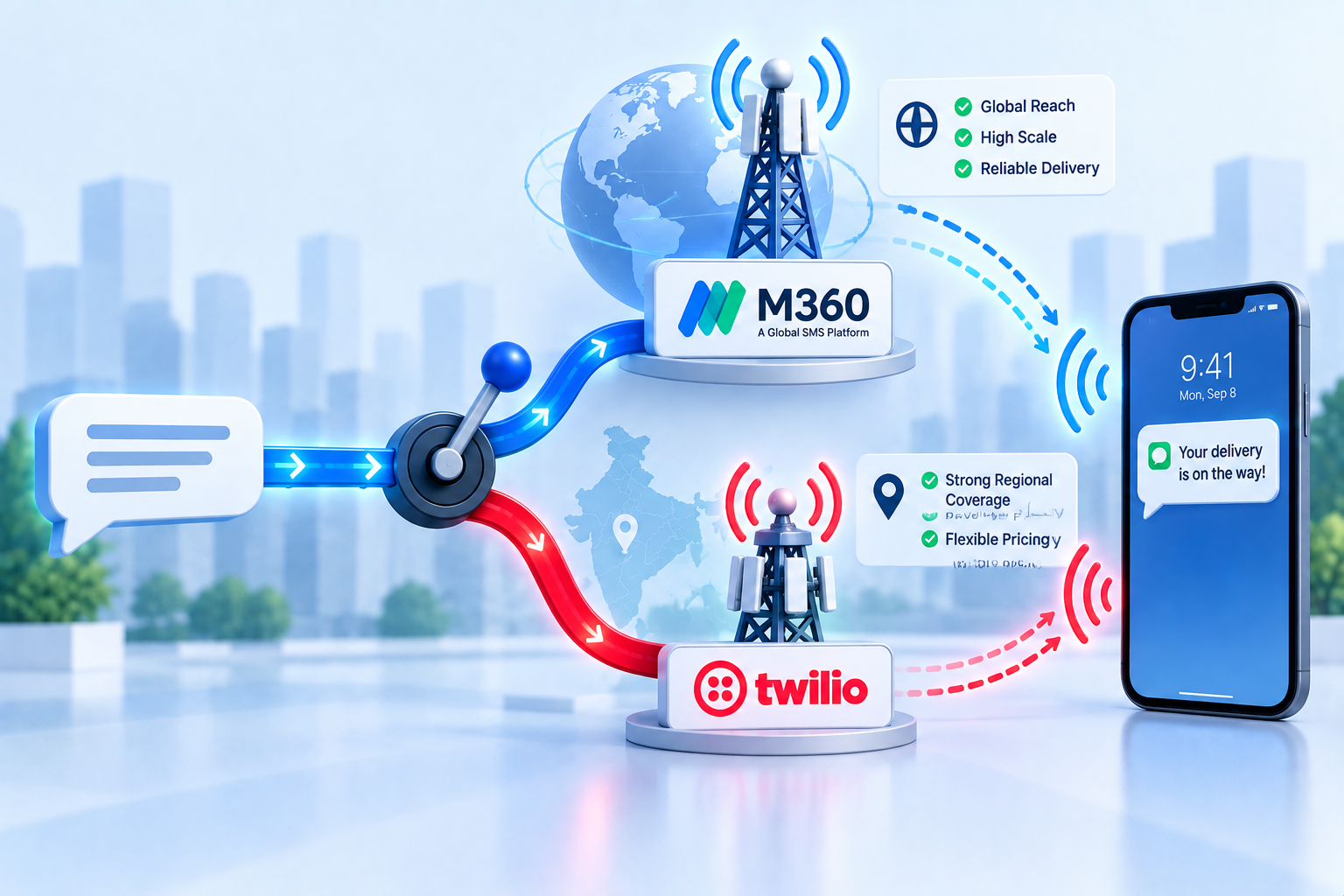
An SMS gateway for delivery notifications is the piece of infrastructure between your dispatch platform and the customer's phone. It takes an "out for delivery" event, turns it into a message, hands it to a mobile carrier and, if things are set up well, tells you whether it was delivered. Geofleet now supports M360 as an SMS gateway alongside Twilio, both configured under Settings, Developer, Integrations, and the addition prompted a question we hear often: which one should we use, and does it actually matter?
It matters more than most teams expect. Two operations can run identical templates and see very different outcomes because one gateway has direct carrier routes in the destination country and the other is sending through a chain of intermediaries. This guide sets out what a gateway does in a delivery flow, the criteria that decide the outcome, how a regional gateway compares with a global one, and how to run both with routing rules.
What an SMS gateway does in a delivery flow
A delivery lifecycle generates a predictable series of customer-facing events. Each one is a candidate for a message, and the gateway carries all of them:
- Order confirmed: the first touch, sets expectations on timing and includes the tracking link.
- Scheduled window: date and slot, with an option to change it before dispatch.
- Out for delivery: the Captain has the parcel; the message includes a live ETA and the branded tracking link.
- ETA update and arriving: a refreshed time when the route changes, then a "10 minutes away" nudge that gets people to the door.
- Delivered: confirmation with a proof-of-delivery link or photo reference.
- Failed attempt: what happened and a one-tap reschedule link, which is the single highest-value message in the set.
- OTP for proof of delivery: a one-time code the customer reads to the Captain for high-value or cash-on-delivery drops.
In Geofleet these events are triggered from order and Captain status changes and rendered from the templates under Alerts and Templates. The gateway does not decide what to say; it decides whether, when and at what cost it arrives, and whether you learn the result.
The path a message takes
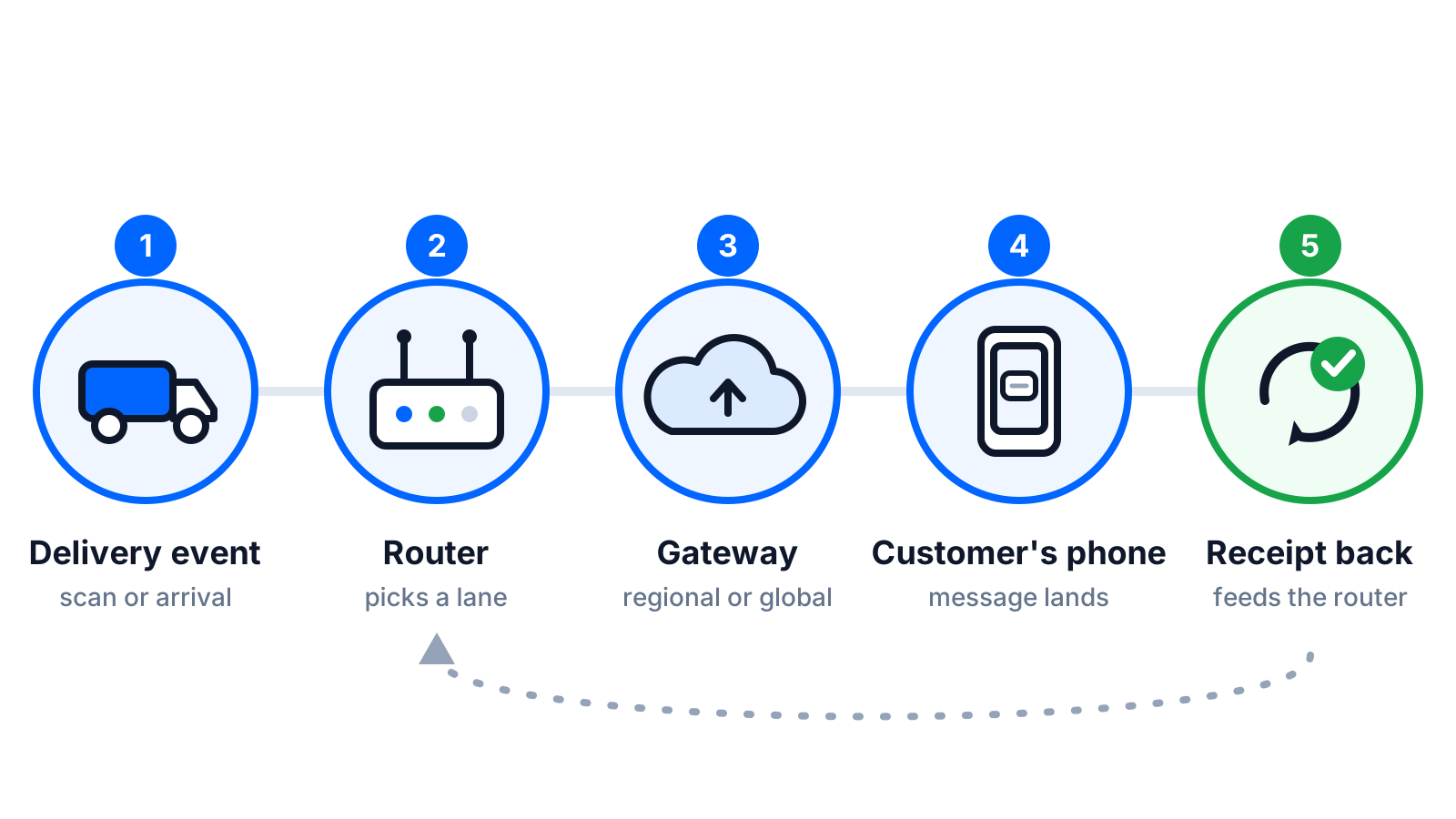
Platform event, template rendered, API call to the gateway, gateway routes to a carrier (directly or through aggregators), carrier delivers to the handset, carrier sends a delivery receipt back up the chain. Every link adds latency and a chance of failure. Gateways with direct carrier connections in a country have fewer links; gateways relying on international wholesale routes have more, and some of those routes are "grey" routes that carriers throttle or block without notice.
The seven criteria that decide whether an SMS gateway for delivery notifications works
1. Deliverability in your countries and local routes
Ask the gateway which carriers it connects to directly in each country you deliver in, and what proportion of your traffic would go over those direct routes. Then test: send a few hundred messages across your real customer base and measure delivered receipts per carrier. Deliverability is a property of a route, not a vendor.
2. Sender ID and registration rules by country
Many countries now require sender IDs and message templates to be pre-registered with regulators or carriers before transactional messages are accepted. India's DLT registration and the US 10DLC regime are two well-known examples; several markets in the Middle East, Southeast Asia and Africa have their own schemes. A gateway that handles registration for you, or at least guides you through it in your market, can save weeks. Ask specifically whether alphanumeric sender IDs (your brand name) are supported per country, since a delivery text from a random long number is more likely to be ignored.
3. Per-message cost, including the parts not on the price list
Compare per-segment pricing per destination country rather than the headline rate, and add sender ID rental, registration fees, delivery-receipt charges and minimum commitments. A cheaper rate on a poor route costs more once you count the failed drops it causes. We deliberately do not quote prices here because they change by country, volume and month; ask for a written rate card for your top five destinations.
4. Throughput at the dispatch peak
Delivery notifications are bursty. When the morning wave dispatches, an operation with 2,000 orders may fire 2,000 "out for delivery" messages in a few minutes. Ask for the messages-per-second limit on your sender ID, whether it can be raised, and how the gateway queues rather than drops overflow.
5. Delivery receipts you can act on
A delivery receipt (DLR) tells you the carrier accepted or rejected the message. Without it you cannot measure the first criterion or trigger a fallback. Check that receipts come back with a reason code and within a usable time, and that they are exposed through the API rather than only in a dashboard.
6. Fallback
What happens when a route fails? A good gateway retries across alternative routes; a good platform can fail over to a second gateway or another channel such as WhatsApp or app push. Ask about both.
7. Support hours and billing in your time zone
When a carrier blocks your sender ID at 7am local time, you need someone who is awake and can talk to that carrier. Regional providers usually win here; global providers make up for it with documentation and self-service.
M360 vs Twilio: a regional gateway compared with a global one
M360 and Twilio are useful examples because they sit at opposite ends of the same spectrum. Twilio is a global communications platform with a single API that reaches most countries, extensive documentation and a large ecosystem. M360 is a regional messaging provider that focuses on carrier-direct connectivity, local sender ID registration and local support in the markets it serves. Neither is "better"; the question is which profile matches where your customers are.
| Criterion | Regional gateway (e.g. M360) | Global gateway (e.g. Twilio) | What to verify |
|---|---|---|---|
| Routes in home markets | Typically carrier-direct | Direct in major markets, aggregated elsewhere | Direct carrier list per country; test DLR rates |
| Coverage outside home region | Limited or via partners | Broad | Which of your destinations are covered directly |
| Sender ID registration | Local expertise, often hands-on | Self-service, documented per country | Who files the paperwork and how long it takes |
| Pricing model | Local currency, local billing | Global pricing, usage-based | Written rate card for your top destinations |
| Throughput controls | Negotiated per account | Documented limits, scalable | Peak messages per second on your sender ID |
| Tooling and API | Simpler, gateway-focused | Rich API, SDKs, logs and analytics | Whether your platform already integrates it |
| Support | Local hours, direct carrier escalation | Global, tiered, largely self-service | Response time for a blocked sender ID |
Test, do not assume
Every claim in the table above is a tendency, not a guarantee. The only reliable way to compare two gateways is to send real traffic to real customers on both and compare delivered receipts, latency and cost per delivered message.
When a regional gateway like M360 makes sense
- Most of your deliveries are in one country or region where the provider has direct carrier routes and you are seeing delayed or missing messages through your current global route.
- Your market requires sender ID or template registration and you want a provider who does it routinely and can escalate to the carrier directly.
- You bill and reconcile in local currency and want invoices and support in local hours.
- Your customers are on carriers that are known to throttle international wholesale routes for transactional traffic.
When a global gateway like Twilio makes sense
- You deliver across several countries and want one integration, one set of logs and one invoice.
- Your engineering team already uses the provider for voice, verification or WhatsApp and wants to keep one vendor.
- You value detailed per-message logs, analytics and a mature API more than local hand-holding.
- Your volumes are modest and local registration is straightforward in your market.
"Our ETA texts were arriving 20 minutes after the Captain did in one city and instantly in another. Moving that city to a regional gateway with a direct carrier route fixed it in a day. We kept the global one for everything else."
— Head of customer experience, e-commerce delivery operator
How to run both gateways with routing rules
Running two gateways is not a compromise; it is the mature configuration. The idea is simple: keep one set of templates, decide per message which gateway should carry it, and fall back to the other when a delivery receipt does not arrive. In Geofleet, both M360 and Twilio are configured as integration cards under Settings, Developer, Integrations, so adding a second gateway is a credentials and routing decision rather than a template rewrite.
Routing rules worth expressing
- By destination country: regional gateway for its home markets, global gateway for the rest.
- By message type: OTP and failed-attempt messages on the highest-deliverability route, marketing-adjacent reminders on the cheapest acceptable route.
- By Shipper or brand: if you run multiple brands with different sender IDs, keep each brand on the gateway where that sender ID is registered.
- By time and volume: if one gateway has a lower peak throughput, cap it and overflow to the other during the dispatch wave.
- Fallback: if no delivery receipt arrives within a threshold, resend through the other gateway once, and log it so the exception shows in reporting.
Measure per route, not per vendor
Report delivered rate, median time to delivery receipt and cost per delivered message by country and gateway. Review monthly. Routes change: carriers renegotiate, regulators add rules, and a gateway that was excellent in one market last quarter may not be this quarter. The two-gateway setup means you can move traffic with a rule change rather than a migration.
A 10-day evaluation plan
- Days 1-2: list your destination countries by volume and the message types you send; get written rate cards and direct-carrier lists from each gateway.
- Days 3-4: register sender IDs where required; note how much each gateway helped.
- Days 5-8: split live traffic 50/50 by customer for your top country; track DLRs, latency and cost per delivered message.
- Day 9: review results by carrier, not just totals; a gateway can be excellent on one carrier and weak on another.
- Day 10: set routing rules, keep both connected, schedule a monthly review of the same metrics.
Do not forget the reply path
If your templates say "reply STOP" or "reply 1 to reschedule", check that inbound messages are supported on the sender ID you chose. Alphanumeric sender IDs are one-way in most countries.
Related reading
Frequently asked questions
What is an SMS gateway for delivery notifications?
It is the service that takes a delivery event from your dispatch platform, turns it into a text message, routes it to the customer's mobile carrier and returns a delivery receipt. Examples include M360 and Twilio; Geofleet supports both.
Is M360 a Twilio alternative for delivery SMS?
In the markets where M360 has direct carrier routes, yes. It is a regional provider with local registration support and local billing, whereas Twilio is a global platform with broad coverage and rich tooling. Many operations use both, routed by destination country.
Why do my delivery texts arrive late or not at all in some countries?
Usually because the message is travelling over an aggregated or international wholesale route that the local carrier throttles, or because the sender ID is not registered in that country. Test with a gateway that has direct carrier connections there and complete local registration.
Do I need to register a sender ID to send delivery notifications?
In many countries, yes. Regimes such as DLT in India and 10DLC in the US require sender IDs and sometimes templates to be registered before transactional messages are accepted. Your gateway should tell you the rules for each destination and help with filing.
Can I use two SMS gateways at the same time?
Yes, and it is the recommended setup once you deliver in more than one market or care about fallback. Route by country and message type, keep the second gateway connected as a fallback, and measure delivery receipts per route.
How do I switch SMS gateways in Geofleet?
Both M360 and Twilio are configured under Settings, Developer, Integrations. Add the new gateway's credentials, choose which gateway handles your notifications, and keep the other connected as a fallback. Your notification templates do not change.