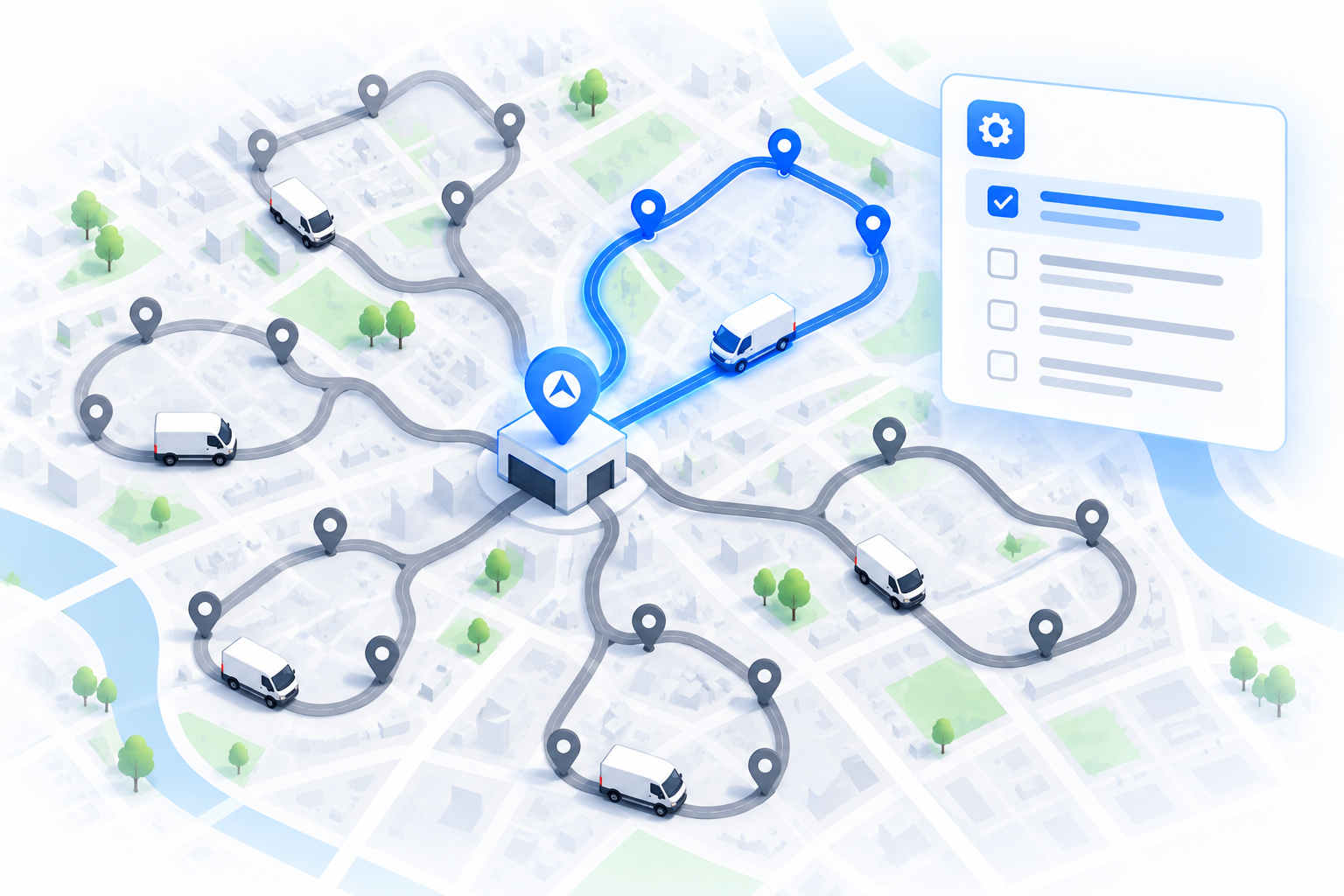
For most dispatch teams, the daily workload is not complicated in theory—assign drivers, sequence stops, handle exceptions, update customers. In practice, the volume and variability make it relentless. A 200-order morning across three hubs produces hundreds of micro-decisions before noon. AI copilots promise to absorb that load. But a copilot that acts on the wrong data, ignores business policy, or cannot be audited is not an assistant—it is a liability.
What copilot actually means in a dispatch context
The word “copilot” gets used loosely. In a dispatch context it means something specific: an AI layer that sits inside the operational workflow, reads live assignments and delivery status, and either recommends or takes actions—within rules the operator has defined. It is not a chatbot bolted onto a separate system, and it is not a reporting tool that shows what happened yesterday.
- Live access to current assignments, route status, and driver locations—not a synced snapshot.
- Awareness of SLAs, time windows, and service commitments per order.
- The ability to take or propose actions inside the existing workflow—not via a separate interface.
- A clear distinction between what the copilot can do autonomously and what requires human approval.
A copilot that can read but not act is a dashboard. A copilot that can act without constraint is an audit failure waiting to happen. The operational value lives in the middle: well-scoped automation with visible reasoning.
The highest-ROI tasks for dispatch automation
Not every dispatch decision benefits equally from automation. The high-value targets share a common profile: they happen at high volume, follow consistent logic, and getting them wrong is recoverable. Rare, high-stakes, or policy-dependent decisions belong to humans—at least until trust and data quality have been established over time.
| Task | Volume | Logic consistency | Cost of error | Automation fit |
|---|---|---|---|---|
| Bulk reassignment after a driver drops | High | High | Recoverable | Strong — automate with review |
| Exception triage and ranking | High | Medium | Recoverable | Strong — copilot ranks, human acts |
| Proactive late-delivery alerts | High | High | Low | Strong — automate fully |
| Pricing or SLA-tier exceptions | Low | Low | Contractual | Weak — keep human |
| Regulated or safety-critical deliveries | Low | Low | Severe | None — human only |
Bulk rerouting and reassignment
When a driver calls in sick or a hub runs 40 minutes behind schedule, the downstream effect touches dozens of orders. Manually reassigning and resequencing those orders consumes 20-30 minutes of dispatcher time that should be going to exception management. A copilot that can bulk-propose reassignments across available capacity—subject to SLA feasibility and vehicle type constraints—turns that into a one-click review.
Exception triage and prioritisation
At any given point in a live operation, 5-15% of active deliveries are in some form of exception state—delayed, unreachable customer, access failure, vehicle issue. The job is to know which exceptions actually need intervention. A copilot that surfaces exceptions ranked by SLA risk, revenue impact, and downstream effect—rather than by time of incident—lets dispatchers spend their attention where it matters most.
Proactive customer communication
Most dispatch teams know a delivery will be late before the customer does. The copilot triggers the right communication at the right moment—not after the window has passed. Automated alerts, ETAs updated from live GPS, and templated messages that reflect actual delivery status reduce inbound contacts and protect CSAT without adding to the dispatcher workload.
"The goal is not to remove dispatchers from decisions—it is to remove dispatchers from decisions that do not require them. Every bulk reassignment the copilot handles correctly is capacity redirected to the exceptions that genuinely need human judgment."
Why guardrails are not optional
Automation without boundaries is how operational incidents happen at speed. Guardrails are not a limitation on copilot capability—they are what makes copilot trustworthy enough to use at all. The practical architecture has three layers.
Scope narrow, then expand
Enable copilot on one recoverable, high-volume decision first—bulk reassignment is the usual choice—and require human review on every action. Widen autonomy only after suggestion-acceptance data shows the logic is trusted.
Permission and role boundaries
Not every user role should have the same copilot capability. A senior dispatcher approving a bulk reassignment is different from a junior operator accepting a single reroute suggestion. Role-based permission structures define what the copilot can propose or execute for each user type—preventing the most common failure mode: an automated action that was technically possible but operationally wrong for that context.
Action caps and change limits
- Maximum number of reassignments the copilot can propose in a single action.
- Limits on how much a suggested route can deviate from the original plan by time or distance.
- Caps on consecutive automated actions that can execute without a human checkpoint.
- Hard blocks on actions affecting orders above a defined value threshold.
Audit logs and reversibility
Every copilot action—proposed or executed—should produce an audit entry: what was done, why it was suggested, which rule drove it, and who approved or ignored it. This is not just a compliance requirement. It is the feedback loop that tells you whether the copilot logic is improving operations or quietly creating patterns you have not noticed yet.
When not to automate
- Safety-critical or regulated deliveries—pharmaceutical cold chain, age-verified goods, hazardous materials.
- High-value or sensitive customer accounts where a service error triggers contractual penalties or escalation.
- Scenarios where the underlying data is ambiguous, missing, or contradicts itself.
- New operational configurations during the first weeks after a hub goes live or after integration changes.
Measuring whether copilot is actually working
The most reliable leading indicator of copilot effectiveness is suggestion acceptance rate—the proportion of copilot recommendations that dispatchers act on rather than override. A high acceptance rate signals that the copilot logic aligns with how experienced dispatchers think. A low rate signals that something in the model, the data, or the scope is wrong.
- Suggestion acceptance rate by action type—reroutes, reassignments, and customer comms may have very different rates.
- Time from exception detection to resolution—this should fall as copilot absorbs triage work.
- Manual override frequency by category—a pattern of overrides in one area signals the automation scope needs review.
- SLA breach rate before and after copilot deployment—the ultimate business outcome measure.
AI copilots work best when scoped to decisions where the logic is understood, the data is clean, and the cost of error is manageable. Start narrow, measure acceptance, and expand scope only as trust—and the evidence behind it—builds.
Related reading
Frequently asked questions
Should a copilot replace dispatchers?
No. A dispatch copilot handles high-volume, rule-based decisions so dispatchers can focus on exceptions and judgment calls that require context, relationship knowledge, or regulatory awareness that AI cannot reliably provide.
How do you prevent a copilot from taking harmful actions?
Through layered guardrails: role-based permissions that define what each user type can approve, action caps that limit the scope of any single automated change, and audit logs that record every decision for review and rollback.
What is a good first automation to enable?
Bulk reassignment when a driver is unavailable is typically the highest-ROI starting point—it is a high-volume, repetitive decision with clear rules and a recoverable failure mode if the copilot gets it wrong.
How do you know if the copilot is helping or creating problems?
Track suggestion acceptance rate and manual override frequency. A high acceptance rate means the copilot logic matches dispatcher judgment. A pattern of overrides in specific scenarios signals that the automation scope or underlying data needs review.
How does Geofleet approach AI copilot in dispatch?
Geofleets AI Command Centre embeds copilot capabilities directly in the dispatch workflow—operating on live operational data, respecting role-based permissions, and providing full audit trails for every agent action and human override.