Ask any operations manager how many browser tabs they have open during peak dispatch and the answer is rarely fewer than five. Map on one screen, order management on another, a chat window for customer updates, a spreadsheet tracking SLA performance, and somewhere in the background a CRM or finance system showing what was promised to whom. Each tool is accurate in isolation. Together, they are a coordination failure waiting to happen.
The five-tab problem in delivery operations
The fragmentation is not accidental. Most logistics operations built their tech stack incrementally—adding a tracking tool when GPS became affordable, bolting on a customer notification system when CSAT became a KPI, exporting to spreadsheets because the operations platform did not report the way the CFO needed. Each addition solved a real problem. The aggregate result is a team that runs on manual reconciliation between systems that were never designed to agree with each other.
- Map shows driver location—but does not know what is in the order or what was promised to the customer.
- Order system knows delivery commitments—but updates status from driver app data that may lag by minutes or hours.
- Communication tools fire customer notifications—but cannot read live route status to know whether the ETA they send is still accurate.
- Spreadsheets track SLA performance—built from exports that are hours old by the time anyone reads them.
- CRM or finance system holds billing and accountability data—updated after the fact, rarely in the line of sight during dispatch.
The cost is not just inefficiency. It is the decisions that get made on the wrong version of reality. A dispatcher who sees “out for delivery” in the order system and “stationary for 40 minutes” on the map has two contradictory signals and no system that reconciles them automatically. That gap is where SLA breaches, customer escalations, and operational errors live.
| Dimension | Five-tab stack | One-tower model |
|---|---|---|
| Source of truth | Each tool disagrees | Single shared order state |
| Status freshness | Minutes to hours stale | Real-time propagation |
| Customer ETAs | Sent from stale data | Derived from live status |
| Leadership view | Yesterday’s export | Same live data as ops |
| Exception response | Manual reconciliation | Acted on in one place |
What a unified operations model actually requires
The one-tower model is not about replacing every tool with a single platform—though that is one valid path. It is about ensuring that all operational data shares a consistent, real-time representation, regardless of how many underlying systems are involved. The requirement is a single source of truth, not a single vendor.
A shared operational data model
Every system that touches a delivery—OMS, TMS, driver app, customer notification engine—needs to read and write to the same canonical representation of an order state. When the driver app marks a stop as attempted, that status should propagate immediately to the order system, the customer notification layer, and the SLA tracker. No polling delays, no manual exports, no version drift.
Consistent status and exception definitions
”Failed delivery” means something different in the driver app, the OMS, and the customer-facing tracking page. Until all systems agree on what each status code means and when it gets applied, the unified data model will produce consistent records of inconsistent labels. Standardising status definitions is unglamorous work—but it is the prerequisite for everything else.
Real-time propagation, not batch sync
Batch exports and scheduled syncs are incompatible with real-time dispatch. A route change at 10:47am should be visible to the customer notification system at 10:47am—not at the next sync window. Event-driven integration, where each state change triggers an immediate update downstream, is the architectural requirement for a genuine operations tower.
"The five-tab problem is not solved by using fewer tabs. It is solved by ensuring that every tab, regardless of the tool behind it, is reading from the same operational reality at the same moment."
Aligning leadership and operations on the same data
Fragmented systems create a secondary problem that is less visible but equally damaging: the gap between what operations teams see in real time and what leadership sees in weekly reports. When the ops team is managing a live SLA crisis and the management dashboard shows a different on-time rate from the previous day, strategic decisions are made on a different version of reality than the one people on the ground are actually living in.
A unified operations model closes this gap. When leadership dashboards draw from the same live operational data that dispatchers use, the conversation about performance stops being a reconciliation exercise and starts being a productive analysis of what is actually happening and why. Metrics stay consistent across teams because they come from one place—not from each team doing its own export and interpretation.
How to transition without disrupting live operations
Transitioning to a unified model in a live operation requires discipline. The instinct is to migrate everything at once; the outcome of that instinct is usually a painful cutover that erodes trust in the new system before it has had a chance to prove itself.
- Start with one hub and a limited order scope—prove the data model works in a contained environment before expanding.
- Standardise status and exception definitions across all systems before migrating data—consistency must precede consolidation.
- Remove duplicate tracking systems one at a time as the unified layer proves its reliability—parallel running is expensive but safer than a hard cutover.
- Establish clear rules for resolving data conflicts during the transition—when two systems disagree, define which one wins and why.
Standardise terms before you consolidate data
If “failed delivery” means three different things across your driver app, OMS, and tracking page, unifying the data just unifies the confusion. Agree on status definitions first — it is the cheapest, highest-leverage step in the whole transition.
The transition timeline varies by operation size and integration complexity, but the principle is consistent: earn the right to expand scope by demonstrating reliability at smaller scale first. A unified operations model that dispatchers trust is worth more than a comprehensive one they work around.
Related reading
Frequently asked questions
Does the one-tower model require replacing all existing tools?
Not necessarily. The goal is a single operational data model with reliable real-time integration—not a single vendor. Existing tools can remain if they can be made to read and write to a consistent shared state without polling delays.
What is the most common cause of failed unification projects?
Inconsistent status and exception definitions. When different systems apply the same label to different states, consolidating the data just consolidates the confusion. Terminology standardisation must happen before data integration.
How long does it take to transition to a unified model?
For a single hub with clean data and modern integrations, four to eight weeks is achievable. Multi-hub operations with legacy systems and complex carrier relationships typically take three to six months when migrated hub by hub.
How do I know if my operation has a five-tab problem?
Common signs: dispatchers re-key the same order into more than one system, the map and the order list disagree about status, support has to ask dispatch where an order is, and weekly reports are reconciled by hand. If any of these happen daily, you are running on more than one source of truth.
How does Geofleet support the one-tower approach?
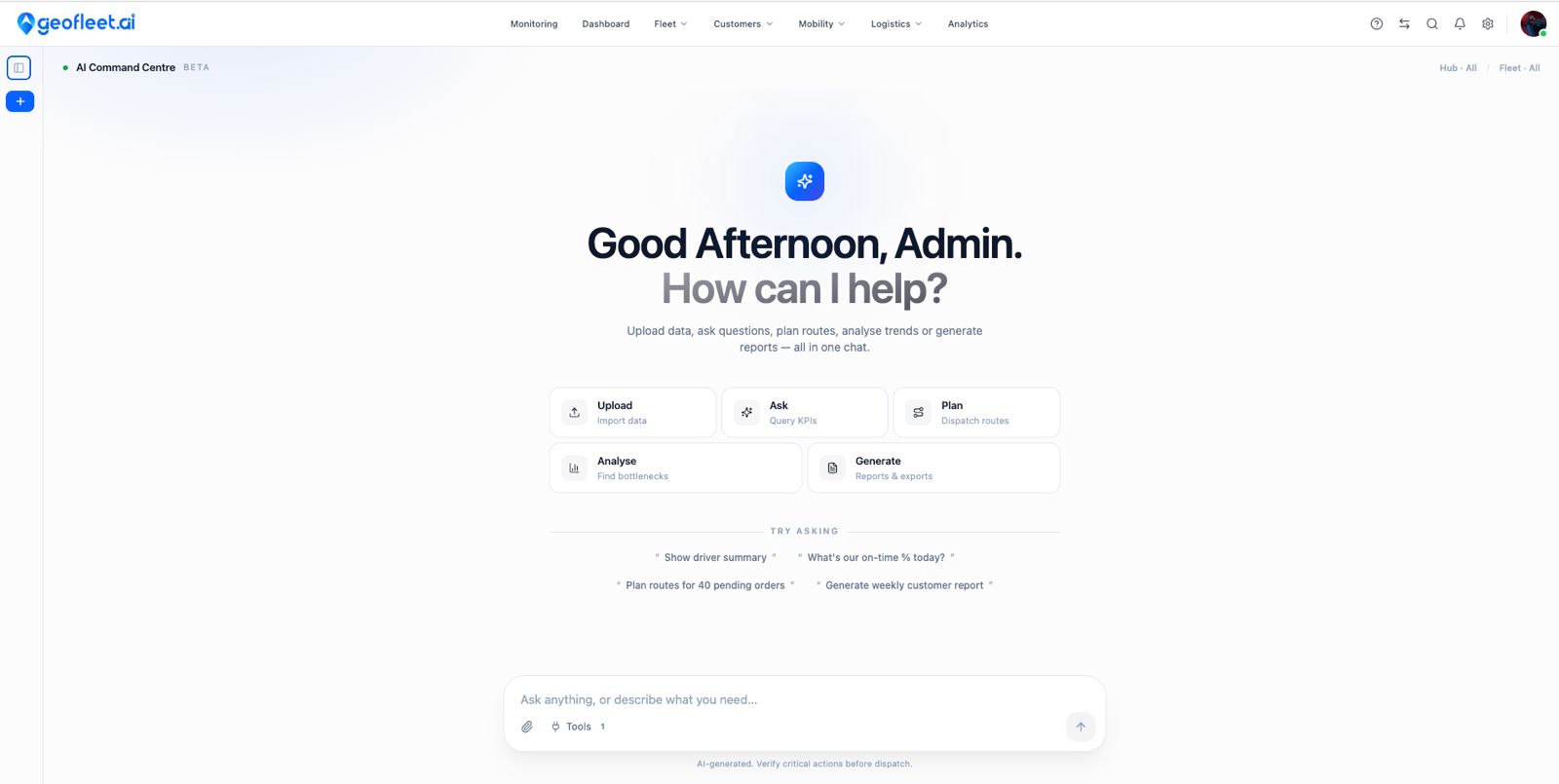
Geofleet Command Centre provides a unified operational view across dispatch, tracking, communication, and analytics—with event-driven integrations that keep every layer of the stack in sync with live delivery status.