Spreadsheets are often the starting point for delivery operations. They are easy to set up, flexible, and require no technical expertise. For small teams managing a limited number of orders, spreadsheets can be an effective solution.
However, as delivery operations grow, spreadsheets quickly become a bottleneck. Manual updates, lack of real-time visibility, and coordination challenges start impacting efficiency and customer experience.
Why Spreadsheets Work Initially
At an early stage, spreadsheets offer simplicity and flexibility, making them a popular choice for small delivery teams.
- Easy to use with minimal setup time
- Flexible structure for managing orders and routes
- Suitable for low order volume and simple operations
Why Spreadsheets Fail at Scale
As operations grow, spreadsheets struggle to handle the complexity of real-time logistics management.
- Manual data entry increases errors and inefficiencies
- Multiple versions create confusion and coordination issues
- No real-time tracking or visibility of deliveries
- Inability to generate accurate ETAs for customers
- Time-consuming manual reporting and analysis
Signs You’ve Outgrown Spreadsheets
If your team is experiencing these challenges, it may be time to move to a dedicated delivery platform.
- Too much time spent managing and updating spreadsheets
- Conflicting versions of delivery plans across teams
- No real-time visibility of orders and driver activity
- Difficulty providing accurate delivery ETAs to customers
- Reporting and performance tracking is slow and manual
What a Delivery Platform Provides
A delivery management platform replaces manual workflows with automated systems that improve efficiency and scalability.
- Automatic order syncing from OMS, POS, or eCommerce platforms
- Optimized route planning and intelligent dispatch
- Driver app with navigation, updates, and proof of delivery
- Real-time tracking with customer notifications and ETAs
- Live dashboards with performance metrics and analytics
Spreadsheets vs Delivery Platform
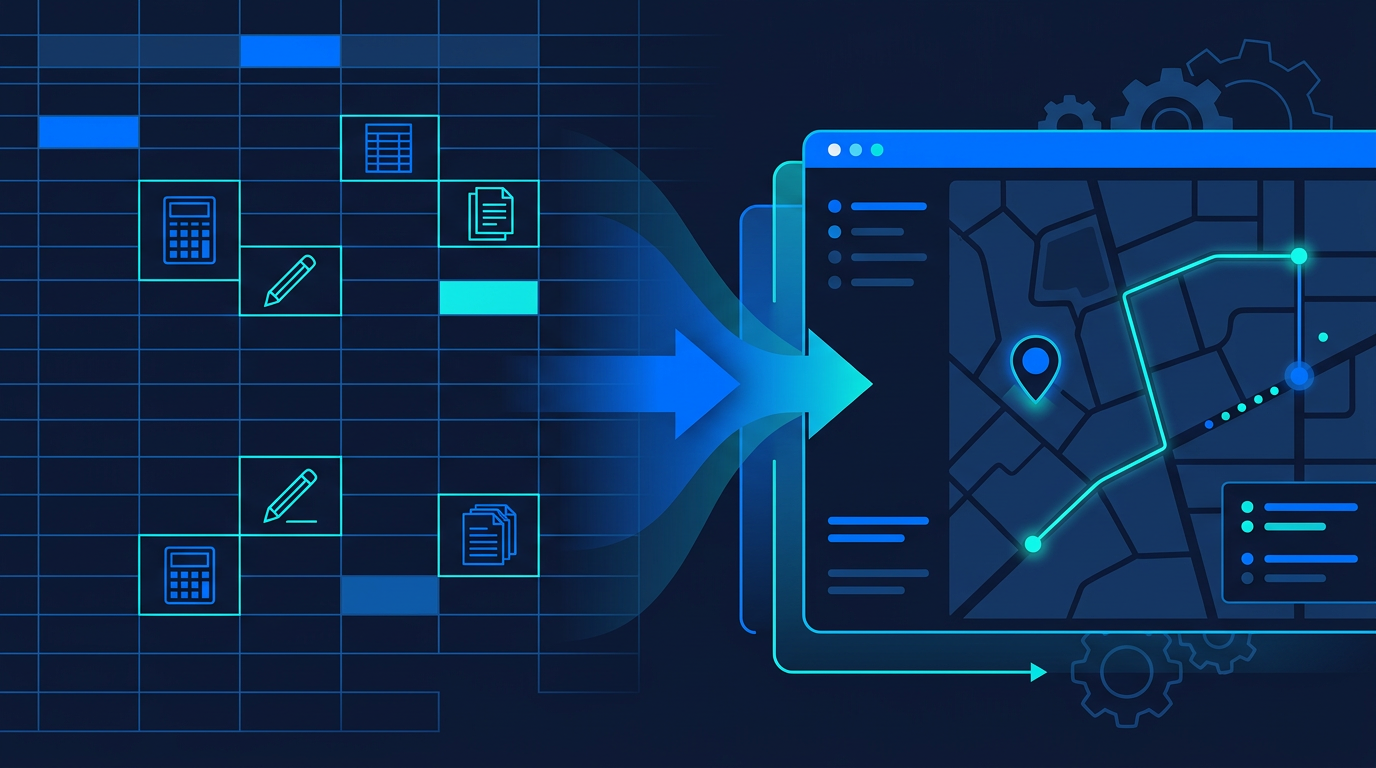
The key difference between spreadsheets and delivery platforms lies in automation, visibility, and scalability. The comparison below lays out where each approach stands on the capabilities that matter as you grow.
| Capability | Spreadsheets | Delivery platform |
|---|---|---|
| Order intake | Manual entry | Auto-sync from OMS/POS |
| Route planning | By hand | Optimized automatically |
| Live tracking | None | Real-time |
| Customer ETAs | Guesswork | Predictive and shared |
| Reporting | Manual, slow | Live dashboards |
| Scales with volume | Poorly | Designed for it |
The real cost is invisible
Spreadsheets feel free, but the hours spent reconciling versions, chasing driver updates, and fielding "where is my order?" calls are a recurring tax that grows with every new order and driver.
- Spreadsheets → Manual, static, and limited visibility
- Delivery platform → Automated, real-time, and scalable
How to Transition Safely to a Delivery Platform
Switching systems can feel risky, but a phased approach ensures a smooth transition without disrupting operations.
- Start with one hub, region, or delivery segment
- Run the new system alongside spreadsheets initially
- Compare performance metrics and operational efficiency
- Gradually shift all operations once confidence is established
Business Impact of Moving to a Delivery Platform
Transitioning from spreadsheets to a delivery platform delivers measurable improvements across operations.
- Reduced manual workload and operational overhead
- Improved delivery efficiency and route optimization
- Higher on-time delivery rates and customer satisfaction
- Better scalability as order volume grows
"After switching to a delivery platform, we improved efficiency and never went back to spreadsheets."
— Head of operations, regional delivery fleet
Final Thoughts
Spreadsheets are a great starting point, but they are not built for scaling logistics operations. As delivery complexity increases, moving to a dedicated platform becomes essential for maintaining efficiency and delivering a better customer experience.
Investing in a delivery platform is not just a technology upgrade—it is a strategic step toward building scalable and efficient logistics operations.
Related reading
Frequently asked questions
When should I move from spreadsheets to a delivery platform?
Consider switching when you spend too much time updating spreadsheets, face conflicting versions across teams, lack real-time visibility, or struggle to provide accurate ETAs to customers.
Why do spreadsheets fail at scale?
Spreadsheets cannot handle real-time coordination. As order volume grows, manual entry increases errors, multiple versions create confusion, and there is no live tracking or accurate ETAs.
What does a delivery platform add over spreadsheets?
A delivery platform automates order syncing, route planning, dispatch, real-time tracking, customer notifications, and analytics in one system, replacing manual workflows.
How can I switch without disrupting operations?
Use a phased transition: start with one hub or region, run the platform alongside spreadsheets, compare performance, and gradually shift all operations once confidence is established.
Roughly how many orders signal it is time to switch?
There is no hard number, but most teams feel the strain once they exceed a few dozen daily orders or coordinate multiple drivers, because manual updates and version conflicts start to cost real time.
Will I lose my existing data when I move off spreadsheets?
No. Most delivery platforms import existing customer, route, and order data, so your historical information carries over rather than being rebuilt from scratch.